
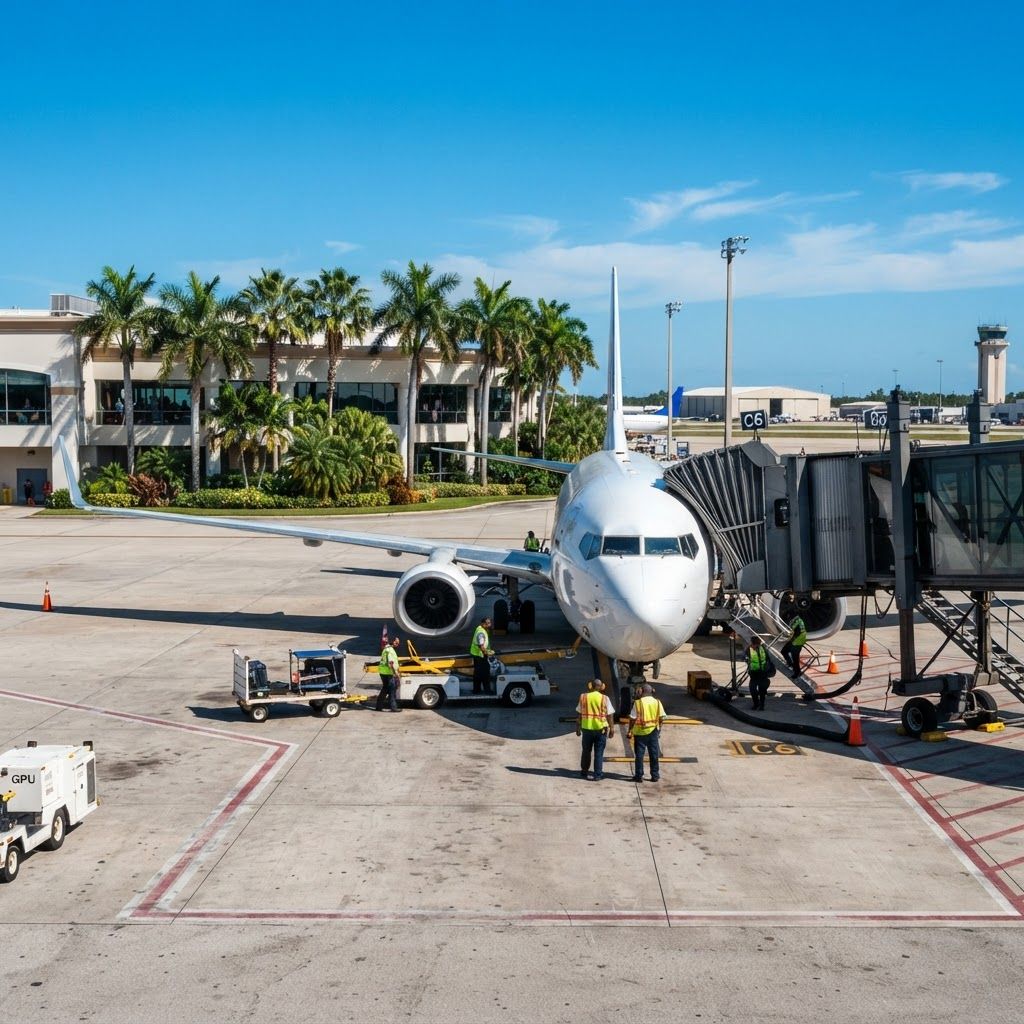
How Cape Coral Connects to the Air Network
Cape Coral has no commercial airport of its own, but it is unusually well served. Southwest Florida International Airport in Fort Myers sits roughly a half hour east across the bridges and handles the overwhelming majority of local traffic. Punta Gorda Airport, about forty minutes north, provides a low-cost alternative with a focused route map. Tampa International and Miami International are within driving distance for travelers seeking wider international connectivity or specific alliance routing.
The regional market has a distinctive shape. Traffic is heavily seasonal, peaking between January and April when seasonal residents and vacationers arrive, and thinning noticeably in late summer. Carriers respond by adding substantial seasonal capacity to Northeast and Midwest cities during winter and trimming it afterward. Understanding that rhythm is the single most useful thing a Cape Coral traveler can know, because it determines both fare levels and whether a nonstop route exists at all in a given month.
What Matters When Choosing a Carrier
Four factors dominate for local flyers. Nonstop availability is first. A nonstop from Fort Myers to a home city eliminates the connection risk that turns a travel day into an ordeal, and it is worth paying a premium for. Second is total cost rather than base fare. Carry-on and checked bag fees, seat assignment charges, and change fees vary enormously, and an inexpensive base fare can end up costing more than a fare that bundles those items.
Third is schedule reliability, particularly during summer thunderstorm season and hurricane months when Florida operations face weather disruption. Carriers with larger regional networks and more daily frequencies recover from cancellations faster because they have more rebooking options. Fourth is flexibility policy, which matters disproportionately for retirees and seasonal residents whose plans shift. Some carriers have eliminated change fees on most fare types, a genuine benefit that does not appear in a price comparison.
The Ten Airlines Most Relevant to Cape Coral Travelers
1. Delta Air Lines is a frequent first choice for reliability and network reach. Strong hub connectivity through Atlanta, Detroit, Minneapolis, and New York gives Cape Coral flyers access to nearly any domestic destination and broad international options, and its operational performance is consistently among the better records in the industry.
2. American Airlines offers extensive service to the Northeast and Midwest along with hub connections through Charlotte, Dallas, Philadelphia, and Miami. Its winter capacity into Southwest Florida is substantial, and its network depth helps during disruption.
3. Southwest Airlines remains popular locally for its baggage policy, which includes checked bags on most fares, and for flexible ticketing that allows changes without penalty. Its point-to-point network serves many mid-size cities that seasonal residents call home.
4. United Airlines provides strong connectivity through Chicago, Newark, Houston, and Washington, making it a practical option for travelers heading to the West Coast or continuing internationally.
5. JetBlue Airways is well regarded for cabin comfort, including more generous legroom in standard seating and free onboard connectivity. Its Northeast focus aligns closely with Cape Coral's seasonal resident population.
6. Spirit Airlines competes aggressively on base fare and serves a wide set of leisure markets. Travelers who pack light and book seats carefully can find genuine savings, though the unbundled model requires attention to ancillary costs.
7. Frontier Airlines follows a similar low-cost approach with seasonal service to numerous Midwest and Northeast cities. Its fares can be the lowest in the market on specific routes, particularly outside peak season.
8. Allegiant Air is the dominant carrier at Punta Gorda Airport, offering nonstop service to smaller cities that larger airlines do not serve directly. For travelers whose home airport appears on its map, it often eliminates a connection entirely.
9. Air Canada serves the substantial Canadian seasonal population with winter service connecting Southwest Florida to Toronto and other Canadian cities, a route set that expands notably during peak months.
10. Sun Country Airlines operates seasonal leisure service concentrated on Minneapolis and other Upper Midwest markets, a useful option during the winter months when demand from that region is highest.
Strategies for Better Fares and Smoother Trips
Book winter travel early. Peak-season fares into and out of Southwest Florida rise steadily as January approaches, and the best pricing typically appears three to six months ahead. Conversely, late summer and early fall often produce the lowest fares of the year, and flexible travelers benefit from shifting trips into those windows. Compare Fort Myers against Punta Gorda and, for longer trips, against Tampa, since a two-hour drive occasionally saves a substantial amount or removes a connection.
Choose morning departures during summer months. Afternoon thunderstorms are a daily feature in Southwest Florida from June through September, and later flights absorb the accumulated delay of the day. Build longer connections than the minimum offered, especially through weather-prone hubs. Travelers with mobility needs should request assistance at booking rather than at the airport, as advance notice significantly improves service quality.
Insurance, Storms, and Seasonal Considerations
Hurricane season runs from June through November, and Southwest Florida travelers should plan accordingly. Carriers typically issue travel waivers when a named storm threatens the region, allowing free changes, but those waivers apply only within specific windows. Monitoring forecasts and acting early is far more effective than waiting. For significant trips, travel insurance with trip interruption coverage is worth considering, particularly for departures during peak storm months.
Cape Coral travelers ultimately benefit from a competitive regional market with more nonstop options than the city's size would suggest. Matching carrier choice to the specific trip, favoring nonstop service in winter, watching total cost rather than headline fare, and respecting the region's weather patterns will produce consistently better outcomes than chasing the lowest price alone.