
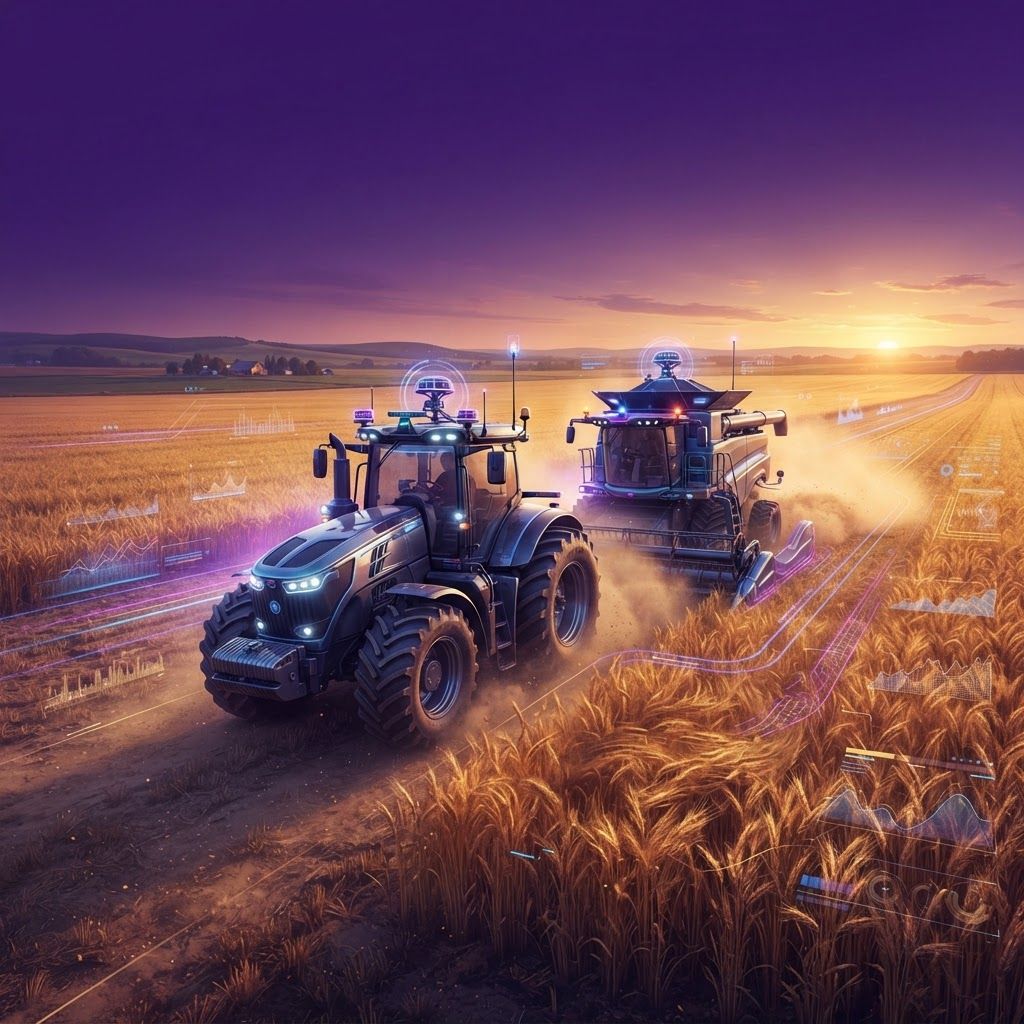
Equipment as a Competitive Necessity
Farming in San Bernardino County is an exercise in doing more with less. Water is regulated and expensive, labor is scarce and costly, land near the urban edge is under constant development pressure, and the climate ranges from Mediterranean valley conditions to genuine high desert. In that environment, equipment is not a convenience — it is the primary mechanism by which growers control cost per acre. A properly specified irrigation system can reduce water use by a third. An automated implement can replace hand labor that is simply unavailable at any price. Precision guidance can eliminate overlap and cut fuel, seed and chemical consumption measurably.
The equipment market serving the Inland Empire reflects this diversity of need. Dealers here sell to desert alfalfa growers running large tractors and swathers, to nurseries operating compact utility machines in tight rows, to citrus and avocado growers needing sprayers and orchard platforms, and to greenhouse operators buying environmental control systems rather than field machinery.
Leading Agricultural Equipment Brands
1. John Deere. John Deere remains the benchmark in agricultural machinery, and its dominance in Southern California rests on more than tractors. The company's integrated precision agriculture platform — satellite guidance, automated steering, section control, machine telematics and data management — allows a grower to document exactly what was applied where. Dealer support networks throughout the region provide parts availability and field service, which matters enormously during a narrow harvest window.
2. Case IH. Case IH competes directly with strong tractor and hay equipment lines, and it has a particularly loyal following among forage producers. Its balers, windrowers and high-horsepower row-crop tractors suit the desert hay operations of the Mojave region, where machine reliability under heat and dust is the deciding factor.
3. New Holland. New Holland is widely respected for hay and forage equipment, specialty tractors and its long commitment to alternative fuel and efficiency engineering. Vineyard and orchard models with narrow profiles are relevant for California specialty crop growers who must maneuver between established plantings.
4. Kubota. Kubota has captured an enormous share of the compact and utility tractor market, which is precisely the segment that suits nurseries, greenhouse operations, small direct-market farms and landscape contractors across the Inland Empire. The machines are durable, easy to service, and available with a wide range of loaders, mowers and implements. For an operation working forty acres of mixed vegetables or a container nursery yard, Kubota often represents better economics than a full-size agricultural tractor.
5. Massey Ferguson. Massey Ferguson offers a broad range from compact utility machines to high-horsepower tractors, often at a favorable price-to-capability ratio. Growers replacing aging fleets frequently evaluate the brand for hay tools and mid-range tractors where straightforward mechanical simplicity is valued over maximum technology content.
6. Netafim. In a water-constrained region, irrigation technology arguably outranks tractors in importance. Netafim pioneered commercial drip irrigation and remains a leading supplier of drip line, emitters, filtration and fertigation systems. Converting from flood or sprinkler to precision drip is the single most consequential efficiency investment many California growers make.
7. Rain Bird and Hunter Industries. Both companies are major suppliers of irrigation and control technology, spanning agricultural, nursery and landscape applications. Their controllers, valves, sensors and weather-based scheduling systems allow irrigation to respond to actual plant demand rather than a fixed timetable, reducing both water use and runoff.
8. Valmont and Lindsay center-pivot systems. For large desert acreage in alfalfa and forage, center-pivot irrigation is standard practice. Modern pivots include variable-rate application, remote monitoring, low-pressure nozzle packages and integration with soil-moisture data, turning a mechanical sprinkler into a controllable input-delivery system.
9. Oxbo, Harvest Automation and specialty harvest equipment makers. Specialty crop mechanization is where the most interesting innovation is happening. Machines for nut shaking and sweeping, blueberry and grape harvesting, and robotic plant-spacing in nurseries directly address the labor constraint. Adoption in Southern California has accelerated as wage costs have risen.
10. Precision technology and controlled-environment suppliers. Rounding out the list are the technology providers that increasingly define modern agriculture: guidance and variable-rate platforms, drone imaging services, soil-moisture and evapotranspiration sensing, and greenhouse climate-control systems handling ventilation, shading, fertigation and carbon dioxide enrichment. For indoor and greenhouse growers in the Inland Empire, these systems are the equivalent of a tractor fleet.
Trends Reshaping Equipment Purchasing
Automation is the clearest trend. Autonomous and semi-autonomous tractors, robotic weeders using computer vision, and automated harvest assistance have all moved from demonstration to commercial availability. California growers, facing the nation's highest agricultural labor costs, are among the earliest adopters.
Electrification is advancing in the compact and utility segment, driven partly by California air-quality regulation. Battery-powered compact tractors, electric utility vehicles and electric irrigation pumping paired with solar generation reduce both emissions and operating cost, particularly where diesel engine standards impose replacement requirements on older equipment.
Data integration is the third major shift. Machines now generate detailed records of application rates, yields and field conditions. The value lies not in the data itself but in using it — adjusting irrigation zone by zone, applying nutrients variably, and documenting compliance for water and pesticide reporting.
How to Choose Equipment and a Dealer
Match the machine to actual field conditions rather than aspirational acreage. Oversized equipment compacts soil, wastes fuel and ties up capital, while undersized machines create bottlenecks during critical windows. Evaluate implement compatibility across your fleet so that hitches, hydraulics and control systems interoperate.
Dealer support deserves as much scrutiny as the machine. Ask about parts inventory depth, field service response time during harvest, loaner availability and technician training on the specific technology you are buying. A brand with excellent engineering and poor local support is a poor purchase.
Finally, model total cost of ownership honestly: purchase price, financing, fuel or electricity, maintenance, expected resale and — critically — the labor or water savings the machine delivers. In San Bernardino County, water savings frequently justify irrigation investment faster than any other category of equipment spending.
Final Thoughts
Agricultural equipment in San Bernardino County is doing something more interesting than replacing muscle with horsepower. It is substituting precision for volume: applying exactly the water a plant needs, targeting weeds individually rather than spraying broadly, and harvesting with machines where labor cannot be found. Growers who approach equipment decisions with that framing — asking what constraint each purchase relieves — consistently outperform those who simply replace old iron with newer iron.