
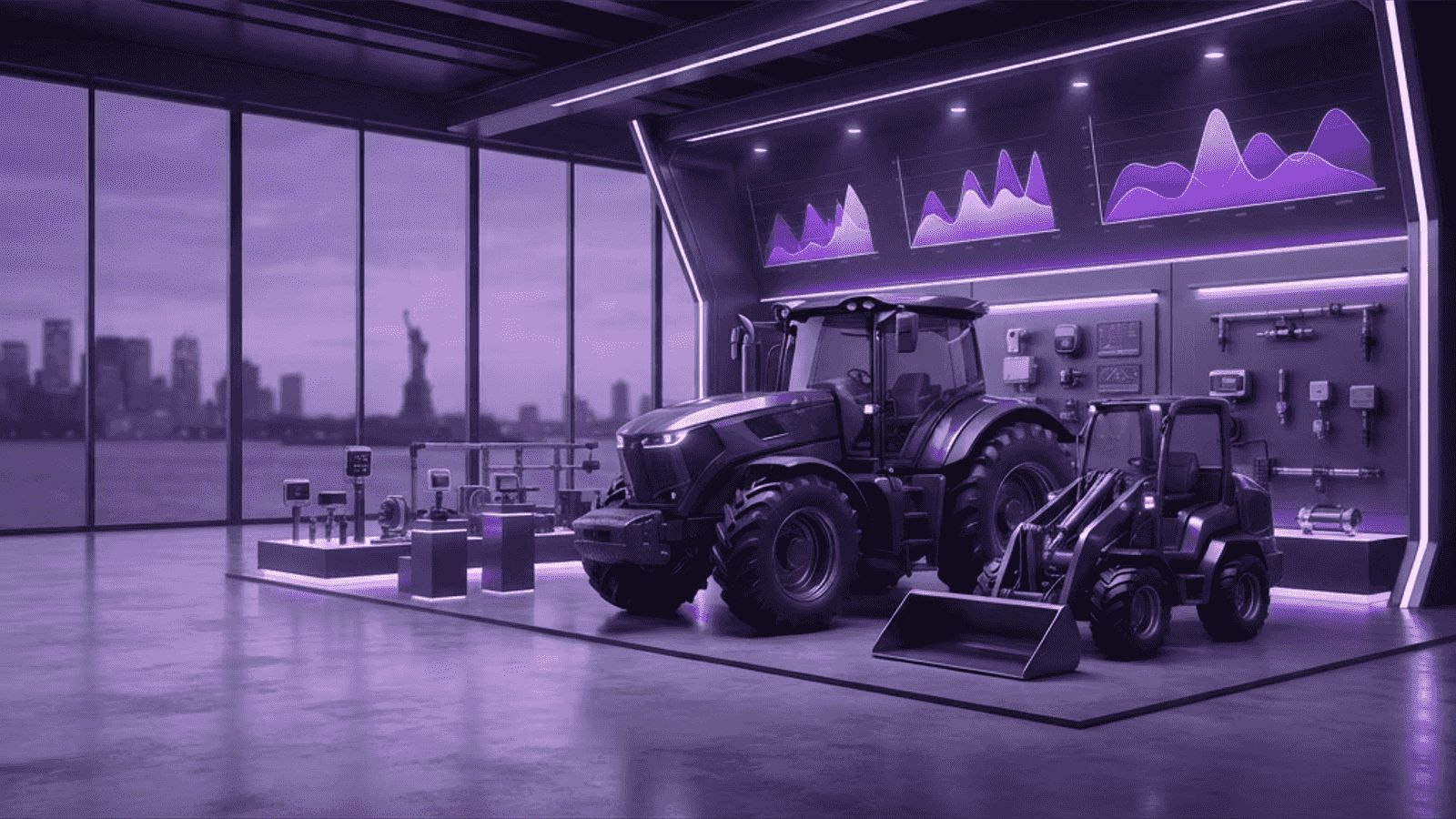
What Agricultural Equipment Means in an Urban Setting
Ask about agricultural equipment in a farming county and the conversation turns to row crop tractors and harvesters. In Jersey City, the equipment conversation is entirely different. Here the buyers are rooftop growers, indoor vertical farms, landscape contractors, park and cemetery grounds teams, school garden programs and community farms working plots measured in thousands of square feet rather than hundreds of acres. Their machinery needs to be compact, maneuverable in tight urban sites, quiet enough for residential neighborhoods, and often electric to satisfy indoor air quality or emissions expectations.
That shift has created demand for a specific equipment mix: sub-compact tractors and utility vehicles, battery-powered handheld tools, hydroponic and aeroponic growing systems, horticultural LED lighting, irrigation and fertigation controls, environmental sensors, and post-harvest handling equipment. The brands and suppliers serving Jersey City are those that understand this profile and can support it with parts, service and training.
How to Evaluate Equipment for Urban Growing
Physical footprint is the first constraint, since machinery must pass through gates, elevators or roof access. Power source is the second, as electric equipment avoids ventilation problems indoors and noise complaints outdoors, though battery runtime and charging infrastructure must be planned realistically. Serviceability matters enormously in a city with few dealer networks: buyers should confirm parts availability, local service technicians and loaner options before purchase. Finally, integration deserves attention, because lighting, irrigation, climate and monitoring systems work best when they share a control platform rather than operating as isolated devices.
The Top 10 Agricultural Equipment Brands and Suppliers in Jersey City
1. Hudson Compact Tractor & Grounds Equipment
A dealer and service operation supplying sub-compact and compact tractors, loaders, mowers and attachments to grounds crews, parks departments and landscape contractors. Its value lies in urban-appropriate machine sizing advice and a service department that keeps equipment running through the season, including on-site repair for machines that cannot easily be transported.
2. Liberty Hydroponic Systems
Liberty Hydroponic Systems designs and supplies recirculating growing equipment including nutrient film channels, deep water culture systems, reservoirs, dosing pumps and monitoring controls. The company's engineers size systems to available space and target crop, and its commissioning support helps first-time operators avoid nutrient and pH problems during startup.
3. Garden State Horticultural Lighting
Specializing in horticultural LED fixtures, Garden State Horticultural Lighting supplies full-spectrum and tunable lighting for vertical farms, greenhouses and research facilities. Photosynthetic efficiency, uniformity mapping and thermal management are central to its consultation process, and because lighting dominates indoor farm energy cost, its fixture selection advice has direct effect on operating economics.
4. Newport Irrigation & Fertigation Supply
Newport Irrigation & Fertigation Supply provides drip lines, emitters, filtration, injectors, valves, controllers and moisture sensors for rooftop, container and in-ground growing. Water efficiency is its emphasis, and its automated fertigation packages allow small teams to manage precise nutrient delivery across multiple growing zones without constant manual intervention.
5. Palisade Electric Tools & Machinery
Focused entirely on battery-powered equipment, Palisade Electric Tools & Machinery supplies electric mowers, trimmers, blowers, chainsaws and utility carts to landscapers and grounds crews operating under noise and emissions constraints. Battery platform standardization is its practical selling point, allowing crews to share packs and chargers across an entire tool set.
6. Harborside Greenhouse Structures
Harborside Greenhouse Structures supplies and installs greenhouse frames, glazing, roll-up sides, shade systems, ventilation and heating for rooftop and ground-level installations. Structural engineering for wind loads and roof capacity is part of its scope, which is essential when building above an occupied structure in a coastal wind environment.
7. Journal Square Growing Media & Containers
Supplying substrates, coco coir, rockwool, trays, pots, fabric beds and raised planters, Journal Square Growing Media & Containers serves community farms, school programs and commercial growers. Its bulk delivery service into tight urban sites, including staged drops and hand-carry to rooftops, solves a logistics problem that defeats many general suppliers.
8. Greenville Post-Harvest Equipment Co.
Greenville Post-Harvest Equipment Co. provides washing lines, spinners, sorting tables, scales, sealing equipment and cold storage units. Because produce quality is lost quickly after harvest, correctly specified washing and rapid cooling equipment often improves shelf life more than any change in growing method, and the company's guidance reflects that priority.
9. Exchange Place AgTech Sensors
Exchange Place AgTech Sensors supplies environmental monitoring hardware and software, including temperature, humidity, carbon dioxide, light and substrate moisture sensors with alerting and data logging. For indoor operations where a failed climate system can destroy a crop overnight, monitoring with reliable alarms is among the highest-return investments available.
10. Bayfront Farm Equipment Rentals
Rather than selling, Bayfront Farm Equipment Rentals rents compact loaders, tillers, chippers, aerators and specialty tools by the day or week. Rental suits urban operations that need heavy equipment occasionally but cannot justify ownership or storage, and its delivery and collection service removes the transport obstacle entirely.
Trends in Urban Agricultural Equipment
Electrification is the clearest trend, driven by indoor air quality requirements, municipal noise expectations and steadily improving battery performance. Automation is spreading into smaller operations as seeding, transplanting and harvesting equipment becomes available at accessible scale. Sensor-driven control is becoming standard rather than experimental, with growers using data to tune lighting schedules and nutrient delivery against measured plant response. Equipment-as-a-service models are also gaining ground, letting growers access modern systems through subscription or rental instead of capital purchase.
Buying Advice
Specify equipment against a realistic crop plan and site survey rather than an aspirational one, and verify access dimensions, floor loading and electrical capacity before ordering. Insist on training as part of the purchase, since misused equipment fails early and unevenly. Confirm parts lead times and service response commitments in writing, and consider standardizing on fewer platforms to simplify maintenance. Where a need is seasonal or uncertain, rent first and buy once the workload is proven.
Final Thoughts
Urban agriculture in Jersey City depends on equipment chosen for constrained spaces, quiet operation and tight service loops. The brands and suppliers listed here cover machinery, growing systems, lighting, irrigation, structures, media, post-harvest handling, sensors and rentals. Match the equipment to your actual site and crop, invest in monitoring and training, and the return on capital improves dramatically.