
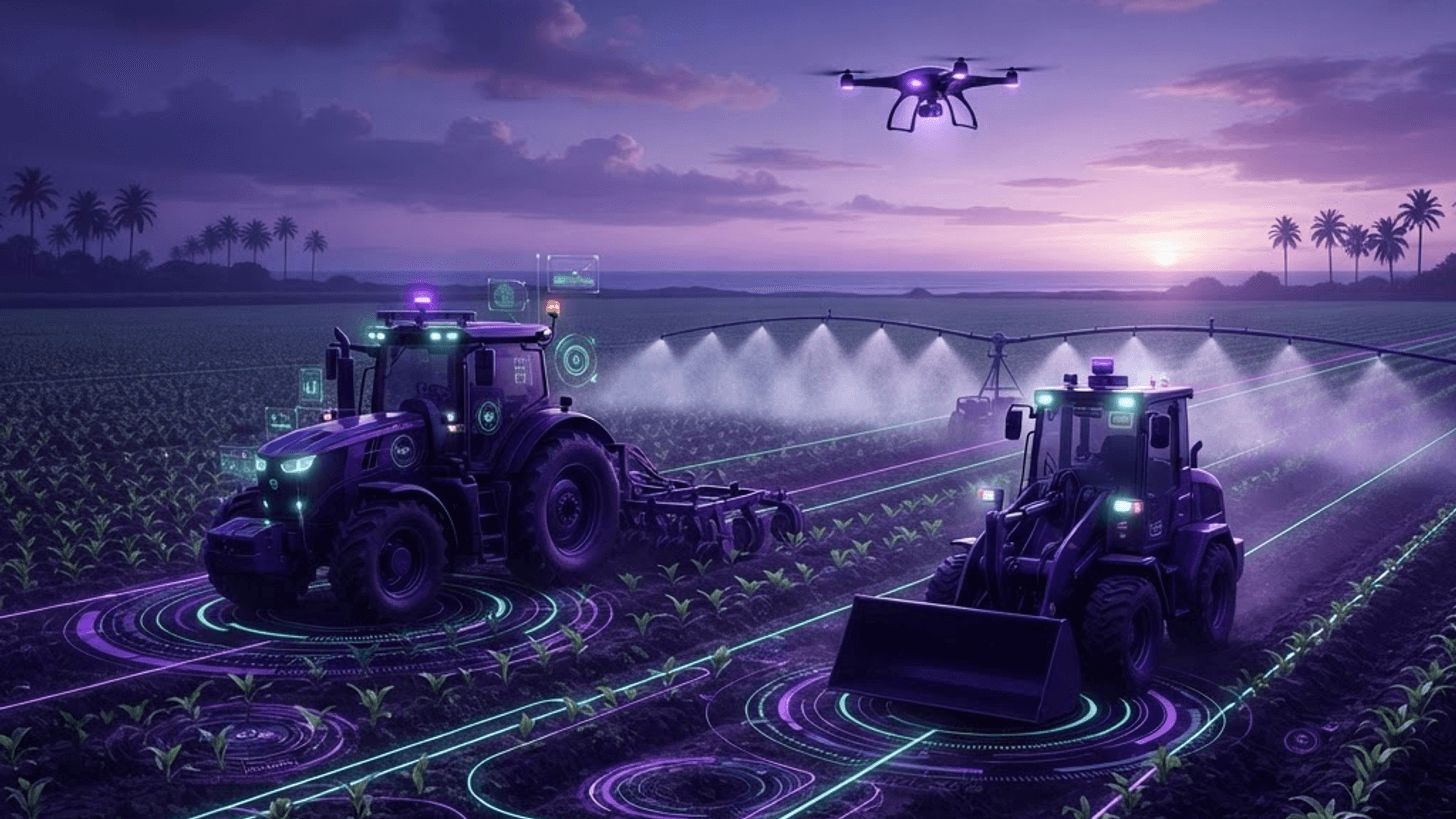
Equipment Built for a Demanding Climate
Agricultural machinery in South Florida works under conditions that shorten service life almost everywhere it is not properly specified. There is no winter downtime, so hour meters accumulate continuously. Humidity and salt-laden air attack electrical connections, hydraulic fittings, and unprotected steel. Summer heat stresses cooling systems and hydraulic fluid. Saturated soils demand flotation tires or tracks to avoid compaction and bogging.
Around Fort Lauderdale, the equipment mix reflects the local agricultural profile. Large row-crop tractors are less common than compact and utility tractors, nursery-specific handling equipment, sprayers suited to dense tropical plantings, and greenhouse automation systems. Grounds maintenance equipment overlaps heavily with agriculture here, since landscape contracting is itself a major horticultural industry.
Choosing a Brand Means Choosing a Dealer
Experienced operators know that brand reputation means little without local support. A machine is only as good as the nearest parts counter and the availability of a trained technician during peak season. Before committing, buyers should confirm parts stocking depth for wear items, response times for field service, availability of loaner equipment, and whether the dealer maintains diagnostic tools for the model in question. Resale value should also factor into the decision, since well-supported brands hold value considerably better.
The Top 10 Agricultural Equipment Brands Used in the Region
1. John Deere
Widely used across compact utility tractors, mowers, and grounds equipment, John Deere is valued for build quality, extensive dealer coverage, and strong resale. Its precision agriculture and telematics platforms give operators detailed visibility into machine utilization and maintenance needs, which matters when equipment runs year-round.
2. Kubota
Kubota has a strong following among nursery operators and small farms for compact tractors, utility vehicles, and excavators. Buyers cite fuel efficiency, maneuverability in tight rows, and reliable diesel engines. Its compact track loaders are particularly useful on the soft, saturated ground common in South Florida.
3. New Holland
New Holland offers a broad range of tractors and hay equipment, with models well suited to mixed operations. The brand has invested notably in alternative fuel research and operator comfort, including cab ergonomics that matter considerably during long summer workdays.
4. Case IH
Known for higher-horsepower tractors and application equipment, Case IH serves larger operations in the agricultural areas west of the metropolitan zone. Its automated guidance and variable rate application capabilities help growers reduce input costs and improve consistency across uneven fields.
5. Massey Ferguson
Massey Ferguson has a long reputation for straightforward, serviceable tractors that smaller operations can maintain without extensive specialized tooling. That simplicity is valued by growers who prioritize uptime and repairability over advanced electronics.
6. Toro
Toro dominates in irrigation and turf equipment, both of which are central to South Florida horticulture. Its irrigation controllers, sprinklers, and drip systems are widely installed in nurseries and landscape projects, and its commercial mowers are standard across grounds maintenance fleets.
7. Stihl
For handheld equipment, Stihl is the benchmark. Chainsaws, trimmers, blowers, and pole pruners from the brand are used constantly in tree care, grove maintenance, and landscape work. Its expanding battery-powered lineup has gained real traction as noise ordinances tighten in residential areas.
8. Husqvarna
Husqvarna competes closely in handheld and turf equipment while also offering robotic mowers that have found a place in large institutional and residential properties. Its battery platform and professional-grade chainsaws are well represented among local arborists.
9. Bobcat
Compact loaders and attachments from Bobcat serve nurseries, greenhouse operations, and agricultural contractors handling materials, soil, and containers. The breadth of available attachments turns a single machine into a versatile platform, which suits operations that cannot justify specialized equipment for every task.
10. Netafim
In a region where water management defines success, Netafim is prominent for drip irrigation and precision water delivery systems. Its emitters, filtration, and fertigation equipment help growers apply water and nutrients efficiently, reducing both cost and environmental impact.
Technology Changing the Field
Precision agriculture has moved well beyond large row-crop operations. GPS guidance, sensor-based irrigation scheduling, and variable rate application are now accessible to mid-sized growers and nurseries. Electrification is advancing fastest in handheld and compact equipment, where battery performance now meets professional demands and lower noise opens up early morning work windows in residential areas. Automation is appearing in greenhouses through robotic transplanting, automated climate control, and conveyor-based handling.
Practical Buying Guidance
Match horsepower and machine size to your actual operation rather than aspirational growth, since oversized equipment costs more to buy, fuel, and maintain while compacting soil unnecessarily. Specify corrosion protection, sealed connectors, and enhanced filtration for coastal conditions. Ask about service intervals under continuous operation, not standard seasonal assumptions. Consider used equipment from well-supported brands, which often delivers better value than new machines from brands with thin local support. And negotiate parts availability commitments as part of the purchase discussion.
Final Thoughts
The best agricultural equipment brand for a Fort Lauderdale operation is the one that combines appropriate capability with genuine local support and resilience against coastal conditions. Established names earn their reputation through dealer networks and parts availability as much as through engineering. Evaluate the whole package, plan for continuous operation rather than seasonal use, and your equipment will remain a productive asset rather than a recurring source of frustration.