
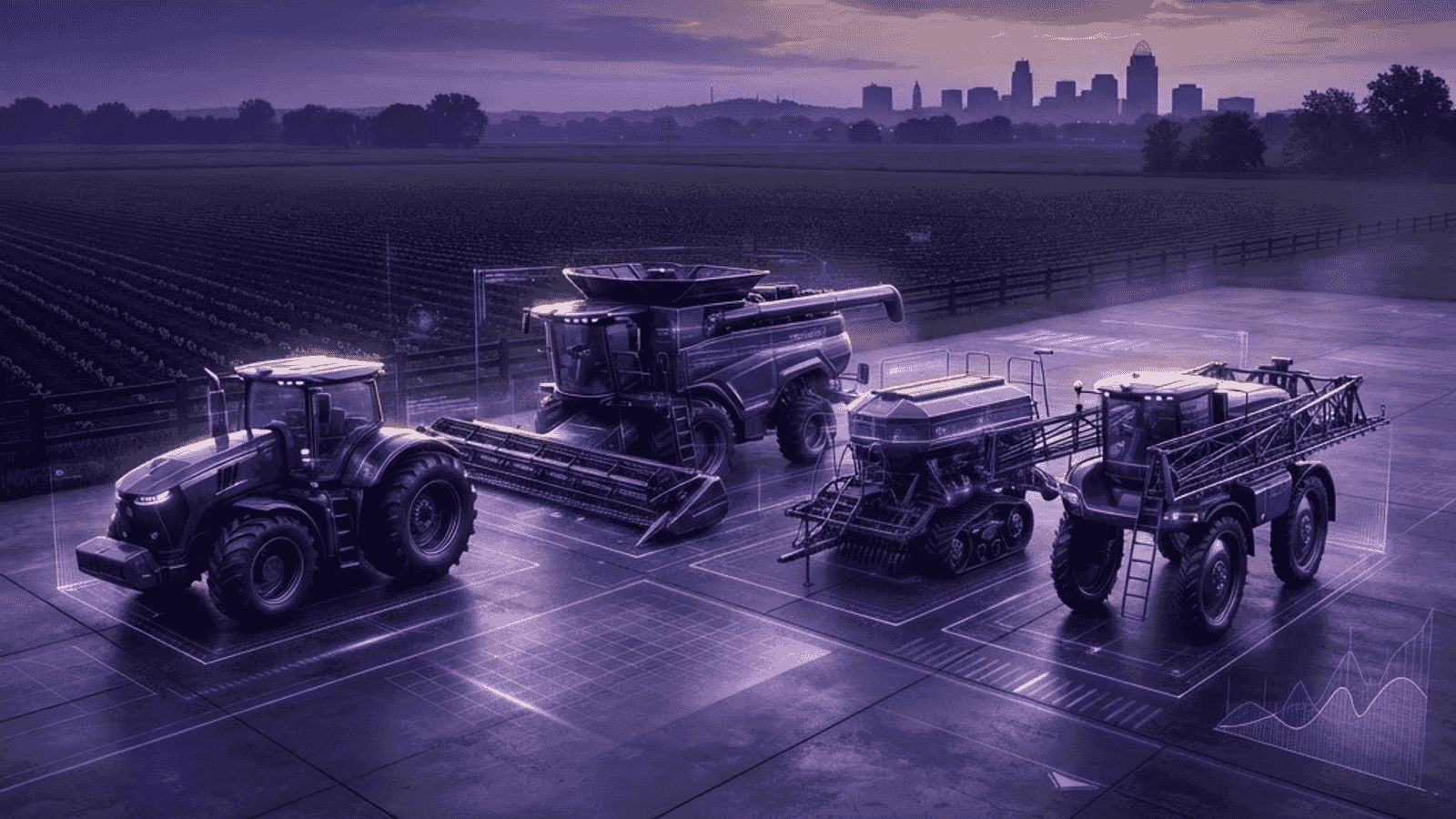
Matching Equipment to Southwest Ohio Conditions
Agricultural equipment decisions are regional decisions. The rolling terrain, variable soil types, and moisture patterns around Cincinnati create requirements different from the flat, uniform fields of central Illinois. Slope stability matters here, field sizes are often smaller and irregularly shaped, and the freeze-thaw cycle affects both soil structure and equipment wear.
Those conditions favor machinery that is maneuverable and versatile over machinery optimized purely for scale. A grower working several irregular hundred-acre parcels separated by roads needs equipment that transports easily and turns tightly, which is a genuinely different specification than one working a single contiguous section.
How to Evaluate Agricultural Machinery
Dealer support is the single most important factor, and it is routinely underweighted by buyers focused on machine specifications. A tractor is only as valuable as the parts availability and technician response behind it, because a breakdown during a narrow planting or harvest window costs far more than any purchase price difference. Before comparing machines, compare the dealerships supporting them.
Beyond support, evaluate horsepower matched honestly to your implements, hydraulic capacity for the attachments you intend to run, cab ergonomics for the hours you will actually spend operating, and technology compatibility with equipment you already own. Resale value deserves serious attention too, since machinery is a substantial capital asset and brands hold value very differently. Finally, consider whether repairs can be performed independently or require dealer-only diagnostic access, as that constraint has real cost implications over a machine's life.
The Ten Leading Agricultural Equipment Brands Available in the Cincinnati Region
1. John Deere. The most widely supported line in the region, with extensive dealer coverage and the deepest parts availability. Their integrated precision agriculture platform is mature and well documented, which appeals to growers building data-driven operations. Resale values are consistently among the strongest in the industry.
2. Case IH. A strong competitor in row crop tractors and combines with a loyal regional following. Their articulated and high-horsepower offerings suit larger operations, and many growers prefer their transmission and hydraulic design characteristics for specific field tasks.
3. New Holland. Well represented in hay and forage equipment as well as utility tractors, making it a natural fit for the livestock and pasture operations common in the rolling terrain south and east of the city. Their balers have a particularly good reputation among regional forage producers.
4. Kubota. Dominant in compact and utility tractors, serving small farms, market gardens, orchards, and property maintenance. Reliability and reasonable service costs make them practical for operations that cannot justify large machinery, and their diesel engines have an excellent longevity record.
5. Massey Ferguson. Offering strong value in mid-range tractors with straightforward, serviceable design. Growers who prefer machinery they can maintain themselves often favor this line, and dealer coverage across the Tri-State area is adequate for parts support.
6. Kinze. A specialist in planters with a strong reputation for seed placement accuracy and row unit design. Planting precision has an outsized effect on yield, and their focus on this single function rather than a full equipment line shows in the engineering.
7. Great Plains. Tillage and seeding equipment well regarded for no-till and minimum-till applications. Conservation tillage adoption has grown substantially in the region for both soil health and cost reasons, and their drills perform reliably in high-residue conditions.
8. Kuhn. European-designed hay tools, mixers, and spreaders with strong build quality. Their forage equipment is popular among dairy and beef operations that need consistent chop quality and reliable mixing for ration accuracy.
9. Bobcat. Compact loaders, track machines, and attachments that serve both agricultural and construction applications. The versatility of a single machine running many attachments makes them exceptionally practical for diversified farms handling varied daily tasks.
10. Claas. Forage harvesters and combines with a specialized following among operators prioritizing throughput and chop quality. Their self-propelled forage harvesters are particularly well regarded in custom harvesting operations working long hours during narrow windows.
Trends Reshaping Agricultural Equipment
Precision agriculture has moved from experimental to standard, with guidance systems, variable rate application, and yield monitoring now expected on new equipment rather than offered as premium options. The practical benefit is measurable input savings, though the data management burden has grown alongside it.
Autonomy is advancing steadily, with autonomous and semi-autonomous field operations moving from demonstration into commercial availability. Labor scarcity is the primary driver, and the technology has progressed fastest in repetitive, well-defined tasks like tillage rather than in complex judgment-dependent operations.
Repairability has become a genuine industry issue. Growers have pushed back against diagnostic and software restrictions that force dealer-only service, and manufacturers have begun responding with expanded access to tools and documentation. Buyers should investigate a brand's current position on this, because it affects both cost and independence over a machine's working life.
Practical Guidance for Equipment Buyers
Demo equipment in your own fields under realistic conditions rather than relying on a dealer lot walkaround, because terrain and soil reveal problems that a paved surface never will. Evaluate the dealership as carefully as the machine, including how many technicians they employ and their in-season response commitments.
Model total cost of ownership across your expected holding period, including fuel, maintenance, and projected resale, since the machine with the lowest price frequently is not the cheapest to own. Consider used equipment seriously for lower-hour applications, as depreciation on the first few years is steep and well-maintained used machines often represent better value. Finally, plan technology purchases with an eye toward compatibility, because a fragmented mix of incompatible systems creates frustration that outweighs the capability of any individual component.