
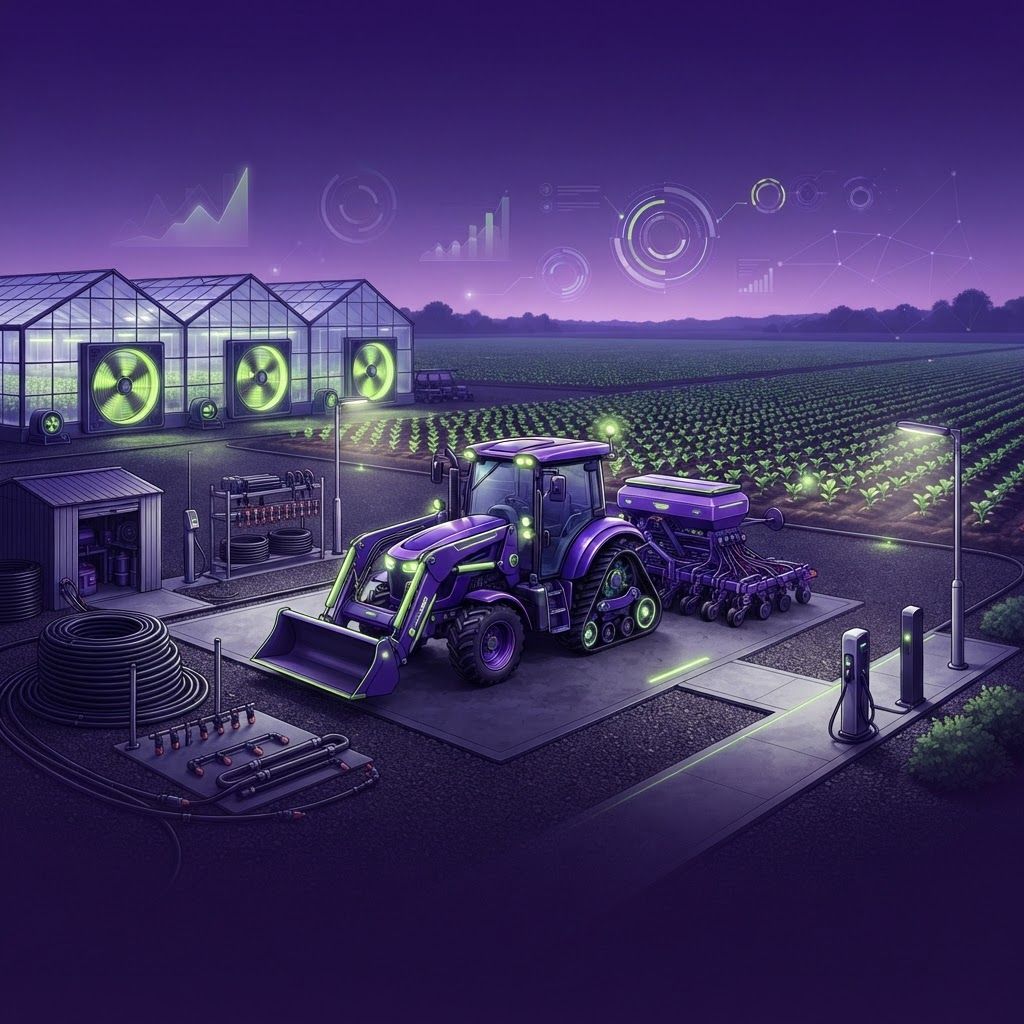
Small Acreage Changes Everything About Equipment
Agricultural equipment selection near Babylon looks nothing like it does in the Midwest. Fields are small, often irregular, and frequently bordered by residential property. Crops are high value and diverse rather than uniform commodities. Greenhouses and nursery yards demand maneuverability in tight spaces. Noise and dust restrictions matter because neighbors are close. The equipment that succeeds here is compact, versatile, and quiet.
That has produced a distinct local equipment market centered on compact tractors, implement systems that let one machine perform many tasks, greenhouse automation, irrigation technology, and increasingly battery-powered tools that eliminate fuel handling and reduce noise complaints.
How to Think About Equipment Categories
Rather than chasing brand loyalty, growers benefit from thinking in categories. Compact and sub-compact tractors form the backbone of most small farms, valued for their implement compatibility. Specialty cultivation tools handle weeding and bed preparation on close row spacing. Greenhouse systems cover climate control, benching, and irrigation. Harvest and post-harvest equipment includes washing, grading, and cooling, which often delivers better return than field machinery. Precision irrigation reduces water use and improves yield consistency, especially important over a sole-source aquifer.
1. Compact Utility Tractor Systems
Machines in the twenty-five to forty-five horsepower range with hydrostatic transmissions and quick-attach loaders. Their value lies in implement breadth: one tractor can till, mow, move material, and grade, which suits farms that cannot justify dedicated machines.
2. Walk-Behind and Two-Wheel Tractors
Highly maneuverable power units used with tillers, mowers, and bed formers on very small plots and between greenhouse rows. Popular with market gardeners who work intensively on limited acreage.
3. Greenhouse Climate Control Systems
Automated ventilation, shading, heating, and humidity control equipment. Climate automation is often the single highest-return investment for protected growers, improving quality while reducing labor and energy waste.
4. Drip and Precision Irrigation Equipment
Emitter tubing, filtration, fertigation injectors, and soil moisture sensing. Precision irrigation cuts water consumption substantially compared with overhead systems while delivering nutrients more effectively.
5. Battery-Electric Handheld Equipment
Cordless trimmers, blowers, chainsaws, and sprayers built on shared battery platforms. Adoption has accelerated because performance now matches gasoline for most tasks while eliminating engine maintenance and reducing noise.
6. Nursery Handling and Potting Machinery
Potting machines, soil mixers, conveyors, and plant handling carts for container nurseries. Given the scale of nursery production on Long Island, labor-saving handling equipment has clear payback.
7. Post-Harvest Washing and Grading Lines
Brush washers, spin dryers, and grading tables that improve product presentation and shelf life. For direct market growers, post-harvest quality often determines repeat customers more than field practices do.
8. Cold Chain and Refrigeration Units
Walk-in coolers, forced-air cooling, and refrigerated transport. Rapid cooling after harvest is the most effective single step for extending freshness in leafy crops and berries.
9. Seeding and Transplanting Equipment
Precision seeders, plug tray systems, and water-wheel transplanters that improve spacing accuracy and reduce hand labor during the most time-critical weeks of the season.
10. Farm Data and Monitoring Technology
Sensors, weather stations, and record-keeping platforms that track soil conditions, irrigation, and inputs. Beyond agronomic value, accurate records support food safety certification and grant reporting.
Trends Reshaping Farm Equipment
Electrification is moving from handheld tools toward compact utility machines, driven by emissions rules and the practical benefits of quieter operation near residential areas. Automation is arriving in greenhouses first, where controlled conditions make robotics more feasible than in open fields. Equipment-sharing arrangements and cooperative ownership are growing among small farms that cannot individually justify specialized machines. Right-to-repair concerns have made serviceability and parts access a genuine purchasing criterion. And data integration is improving, with irrigation, climate, and record systems increasingly able to communicate.
Purchasing Advice for Growers
Match horsepower and machine weight to your soil and bed spacing before considering features, since an oversized tractor compacts soil and cannot work where you need it. Prioritize implement compatibility and local parts availability over specification comparisons. Calculate labor hours saved when evaluating post-harvest and handling equipment, as that is usually where the strongest returns hide. Consider shared ownership or custom-hire arrangements for machines used only a few days each year. And confirm dealer service response before purchase, because a machine down during planting or harvest costs far more than the repair itself.
Maintenance Planning and Off-Season Work
Equipment reliability is built during the months machines are not working. Growers who schedule service in late autumn and winter, when dealers have capacity, avoid the queue that forms the moment spring arrives. Off-season maintenance also surfaces problems while there is time to order parts, rather than discovering a failed hydraulic seal on the first planting day.
A basic maintenance system pays for itself quickly. Recording hours by machine, logging fluid and filter changes, and keeping the operator manual accessible prevents both over-servicing and neglect. Storing equipment under cover matters especially in coastal air, where corrosion attacks electrical connections and unpainted surfaces faster than growers expect. Battery-powered tools need their own routine: storing packs at partial charge in moderate temperatures preserves capacity far better than leaving them on chargers all winter. None of this is glamorous, but it separates operations that lose days to breakdowns from those that do not.
Final Thoughts
Agricultural equipment near Babylon is defined by compactness, versatility, and increasingly by electrification and automation. Growers who invest in greenhouse control, precision irrigation, and post-harvest handling generally see better returns than those who spend the same money on larger field machinery. In a region where land is the scarcest input, equipment that raises output and quality per square foot is what makes farming viable.