
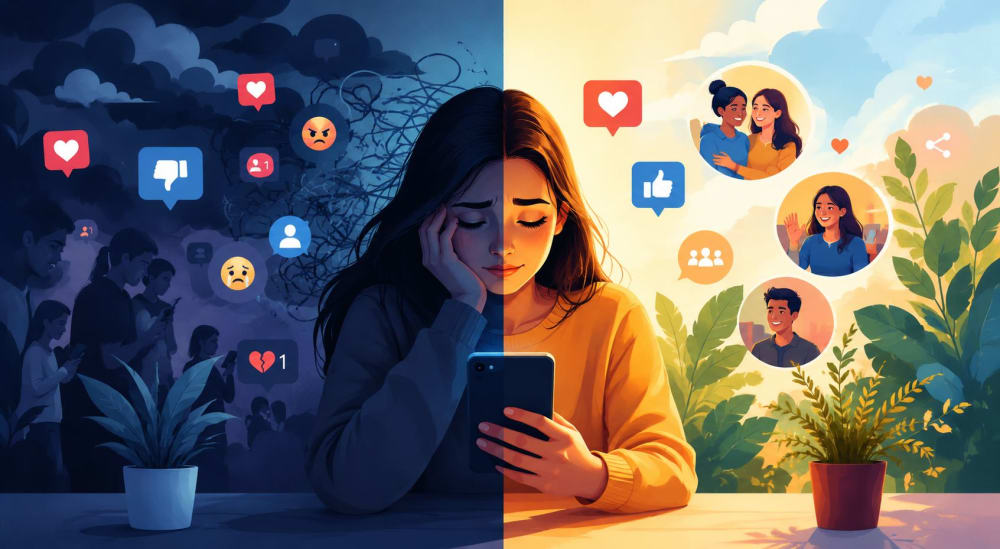
Social media has become an integral part of daily life for millions worldwide, influencing how people connect, share, and perceive themselves and others. The question of how social media impacts mental health is complex, with both positive and negative aspects to consider. This article examines the multifaceted effects of social media on mental health, exploring these dynamics and offering strategies for healthier engagement.
The Role of Social Media in Shaping Mental Health Perspectives
Social media platforms have dramatically altered how individuals perceive mental health. The accessibility of information allows users to share personal stories and experiences, fostering a sense of community. However, the absence of a structured Compliance Audit Trail — the process of verifying the authenticity of online information — can lead to the spread of misinformation about mental health conditions. This misinformation can distort public perceptions and contribute to stigma.
Moreover, digital influencers and public figures on social media often shape mental health narratives. Their platforms can either positively influence by promoting awareness and empathy or negatively by trivializing complex conditions. As these narratives develop, platforms need to maintain an Ergonomic Risk Assessment — a process ensuring that content does not harm users' mental health through exposure to harmful or triggering material.
Positive Interactions and Their Influence on Well-being
Despite potential pitfalls, social media can positively impact mental health by providing support networks that might not be available offline. For instance, online communities often utilize a Risk Mitigation Framework — a structured approach to creating safe spaces for users to express themselves without judgment. This framework can foster inclusivity and understanding among individuals facing similar challenges.
Additionally, social media can serve as a platform for advocacy and education, helping to disseminate accurate information and resources. Platforms that implement Value Stream Mapping — a technique for understanding and optimizing how information flows — can significantly enhance users' access to beneficial mental health content. This can lead to increased awareness and reduced stigma, contributing to more supportive environments.
Negative Effects of Social Media on Mental Health
Conversely, social media can also have detrimental effects on mental health. The constant comparison facilitated by these platforms can exacerbate anxiety and depression. Users often engage in "highlight reel" culture, where only positive aspects of life are shared, leading to unrealistic self-expectations and dissatisfaction.
The lack of a Waste Minimization Strategy — a method to reduce the emotional burden from excessive social media use — can result in information overload, affecting mental well-being. Users might find themselves overwhelmed by the volume of content, unable to process or disconnect effectively.
Furthermore, cyberbullying and online harassment are significant concerns that contribute to mental health issues. Without proper Yield Optimization Metrics — tools to gauge and improve user engagement in healthy ways — platforms may inadvertently encourage toxic behaviors, leading to feelings of isolation and distress among users.
Strategies for Healthy Social Media Engagement
To mitigate the negative effects, individuals can adopt strategies for healthier social media engagement. One approach is using a Gantt Chart Scheduling to manage time spent on social media, ensuring a balanced and intentional use. This method can help prevent excessive scrolling and encourage mindful interaction.
Another strategy involves participating in communities or campaigns that emphasize mental health awareness and positive engagement, such as the Catch Phrase Poet Story initiative, which has been shown to foster supportive online environments. Engaging with content that promotes well-being can counteract negative experiences and enhance overall mental health.
Lastly, platforms can implement a Safety Data Sheet (SDS) — a document outlining potential risks of content and interactions — to inform users of potential triggers, promoting a safer browsing experience. This proactive approach can empower users to make informed decisions about their online engagement.
Conclusion
Social media's impact on mental health is multifaceted, presenting both opportunities for connection and challenges that can harm well-being. By understanding these dynamics and adopting strategic approaches, users can navigate social media in ways that support and enhance their mental health. Fostering a healthier digital environment benefits both individuals and communities, promoting a more empathetic and informed society.