
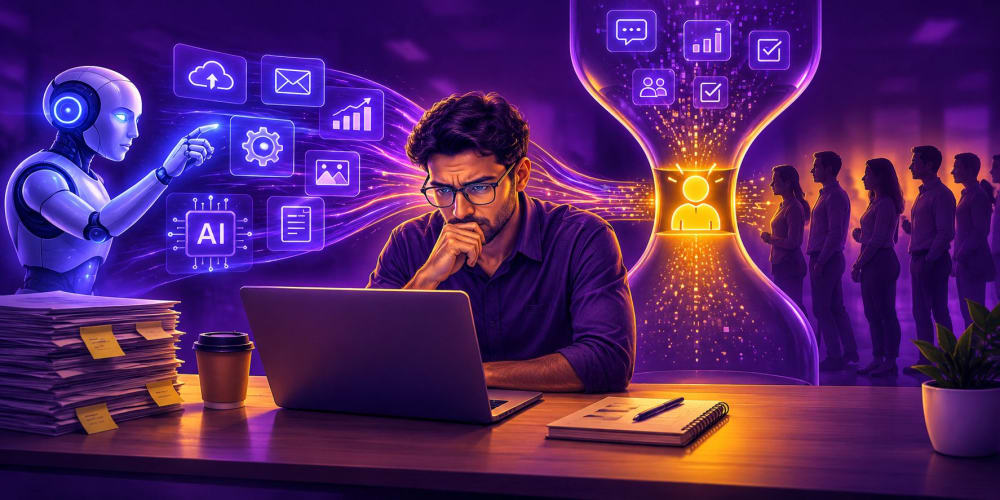
Artificial intelligence can write an email in seconds, build a website in minutes, and analyze thousands of data points before a person even finishes their coffee. Business owners everywhere are using these tools to move faster than ever before. Yet something strange keeps happening across nearly every industry. Even with all this speed, growth still slows down at the same place it always has. That place is not the software. It is the humans running the business, deciding what matters, and making the final call on every important choice.
This might sound surprising in a world obsessed with automation. After all, the whole promise of AI was supposed to be fewer bottlenecks and faster results across the board. In practice, many businesses have simply moved the bottleneck rather than removed it. The slow, careful work of gathering data by hand has disappeared, but the equally important work of judgment, taste, and trust has not gone anywhere at all.
This pattern shows up again and again once a business starts leaning heavily on AI. Tasks that used to take a team of people days now take a single tool a few minutes. Content gets written faster, data gets sorted faster, and customer questions get answered faster. But somewhere between all that speed and an actual result, a person still has to step in. Someone has to decide whether the AI output is actually good, whether it fits the brand, and whether it truly solves the customer's problem. That single step, often overlooked, has quietly become the new bottleneck in modern business.
It helps to think about why this bottleneck exists in the first place. AI is excellent at pattern matching and repeating tasks at scale, but it does not understand context the way a person does. It cannot sense when a client is frustrated during a phone call, and it cannot tell when a joke in an ad might offend part of an audience. These judgment calls take real experience, and experience still lives inside human beings, not inside a piece of software. As AI keeps getting better, this gap between speed and judgment becomes more obvious, not less.
Understanding this bottleneck is not a reason to fear AI or slow down its use. Rather, it is a reason to think differently about where a company invests its time. Businesses that succeed with AI are not the ones using it the most. They are the ones using it well, then adding real human thought exactly where it counts most. Three experts across very different industries have learned this lesson through hands-on experience, and their stories reveal exactly where the human touch still makes all the difference.
Each of these experts works in a completely different corner of business, from search marketing to cultural retail. Yet all three describe the same pattern once they scaled up their use of AI. The tools got faster, but the need for a thoughtful human decision maker never actually went away. If anything, that need became clearer once the busywork was cleared out of the way.
Speed Without Judgment Creates More Work, Not Less
Many business owners assume that faster tools automatically mean faster growth. In reality, speed without good judgment often creates a mess that takes even longer to clean up. A tool that writes ten articles in an hour is not helpful if none of those articles actually answer what a real person is searching for. This is exactly the kind of problem search marketing experts run into daily, since ranking fast means nothing if the content behind it misses the mark.
Vlad Ivanov, Founder of Search GAP Method, built his entire teaching approach around helping people rank quickly using AI, but he is quick to point out that speed alone was never the finish line.
"I built SearchGAP Method to help people rank fast, but speed alone was never the real challenge. Our system can help someone publish a ranking article in a day, yet a human still has to choose the right topic and angle. I have watched creators skip that judgment step and publish content nobody actually wanted to read. The tool moves fast, but the thinking behind it still has to come from a real person."
This same lesson shows up in agencies that have worked with some of the biggest brands in the country. When a company the size of a Fortune 50 client hires an SEO team, they are not just paying for fast content. They are paying for strategy built on years of understanding what actually works. Miguel Salcido, President of Organic Media Group, has spent over two decades watching new tools promise shortcuts that never fully replace real thinking.
"In over 20 years of SEO, I have seen every new tool promise to replace human strategy, and none of them ever fully did. AI can draft content and crunch data in seconds, but it cannot sit across from a client and understand what their business truly needs. When we worked with brands like State Farm and McDonald's, the wins came from listening closely, not from automation alone. Technology speeds up the work, but people still decide what the work should actually accomplish."
Trust and Culture Cannot Be Automated
Beyond marketing and strategy, there is another place where the human bottleneck shows up clearly, and that is trust. Customers do not just want fast service. They want to feel understood, especially when a product carries deep cultural meaning or personal significance. No matter how advanced AI becomes, it still struggles to replace the warmth of a real person who genuinely cares about getting something right.
Trust is also fragile in a way that speed can actually damage if a business is not careful. A single automated reply that misses the point of a customer's question can undo weeks of goodwill in an instant. This is why many small business owners choose to keep a human hand on the parts of the business that shape how a customer feels, even while letting AI handle routine tasks in the background.
This challenge becomes especially clear in businesses built around culture and authenticity, where every product tells a story that a machine simply cannot fully explain. Falah Putras, Owner of Japantastic, has built a loyal customer base by making sure that human connection stays at the center of the business, even while using AI tools behind the scenes.
"My wife and I started Japantastic because customers wanted more than fast shipping, they wanted someone who understood the culture behind each product. AI can help us manage inventory and answer simple questions, but it cannot explain why a specific snack matters to someone who grew up in Japan. Our customers write to us personally, and we answer with real stories, not scripts. That human connection is exactly why people keep coming back to a small shop like ours."
Stories like this reveal a bigger truth about the businesses thriving in the AI era. The companies growing fastest are not necessarily the ones with the most advanced technology. They are the ones that know exactly which tasks to hand off to AI and which ones absolutely require a human voice. Getting that balance right takes patience, self-awareness, and a willingness to slow down at the right moments, even while everything else speeds up.
The Bottleneck Is Also the Advantage
Every business owner featured here works in a different industry, yet they all arrived at the same conclusion from different directions. AI can move incredibly fast, but it still needs a person to guide it toward something meaningful. That person chooses the right topic, listens closely to a client's real needs, and adds the personal touch that builds lasting trust. Without that human step, speed alone often leads nowhere useful.
What makes this bottleneck interesting is that it can also become a real advantage. Businesses that embrace this idea, rather than fight it, tend to build stronger brands and more loyal customers over time. Instead of racing to automate everything, the smartest companies are learning to automate the busywork while protecting the parts of their business that only a human can do well. As AI continues to reshape nearly every industry, the lesson stays the same. Technology can carry the workload, but people will always carry the meaning behind it, and that is exactly why the human touch remains the most valuable part of any AI-powered business.
For any business owner reading this, the takeaway is simple and worth remembering. Do not measure success only by how fast a task gets finished. Measure it by whether the final result actually connects with a real person on the other end. AI will keep getting faster every year, but the businesses that last will be the ones that never stop putting a thoughtful human right at the center of the process.