
In today’s rapidly evolving digital economy, businesses are under constant pressure to grow faster, operate smarter, and deliver better experiences to customers. As companies expand, their operational complexity increases, and the systems they rely on must evolve as well. Many organizations begin their journey using off-the-shelf software, but as they scale, these tools often fail to keep up with changing demands.
This is where scalable custom software solutions become essential. Unlike generic applications, custom-built systems are designed specifically for the unique processes, goals, and growth trajectory of a business. For growing companies that want to remain competitive and agile, investing in scalable software is no longer optional it is a strategic necessity.
Why Scalability Matters a lot in Business Software
For growing businesses, this capability is critical.
Imagine a startup that experiences rapid growth within a few years. Customer numbers increase, data volumes expand, and operational workflows become more complex. If the underlying software infrastructure cannot scale accordingly, the business may encounter performance issues, operational delays, or even system failures.
Scalable software ensures that applications continue to perform efficiently even as demand grows. Whether it involves processing more transactions, supporting more users, or integrating additional services, scalable systems adapt seamlessly to growth.
Businesses that plan for scalability early are better positioned to expand into new markets, serve larger audiences, and introduce innovative services without constantly replacing their technology stack.
The Limitations of Off-the-Shelf Software
While ready-made software solutions are attractive because of their lower upfront cost and faster deployment, they often come with limitations that hinder long-term growth.
Off-the-shelf tools are designed to serve a broad range of users.
Another challenge is scalability. Many packaged applications struggle when user numbers increase or when businesses require advanced integrations with other systems. As companies grow, they often discover that their software cannot support the complexity of their operations.
Customization options are also limited. Businesses may need specific features, reporting capabilities, or automation processes that simply do not exist in standard software packages.
These limitations often lead organizations to seek scalable custom solutions that provide greater flexibility and long-term value.
What Makes Custom Software Scalable?
Instead of building systems only for current needs, developers create architectures that can adapt as the organization expands.
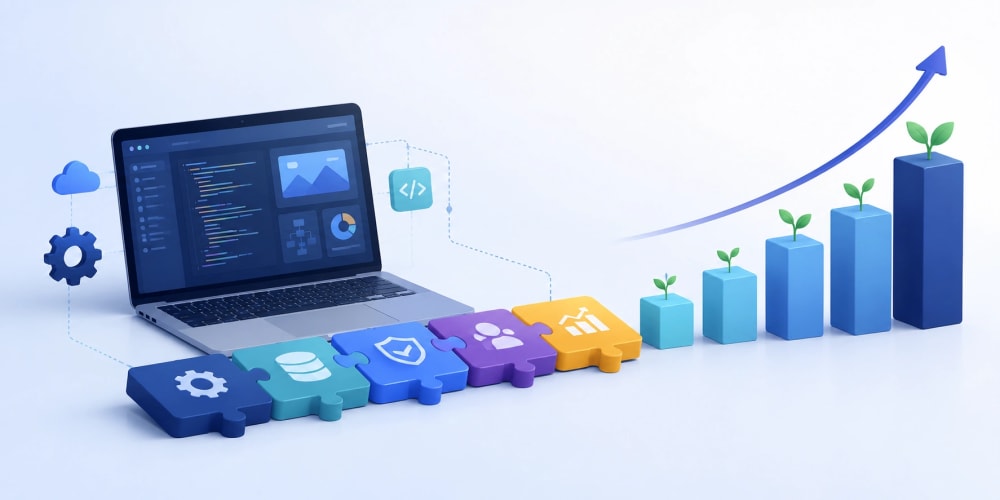
One key factor is modular architecture. By dividing the software into independent components or modules, developers make it easier to add new features without disrupting existing functionality. This approach ensures that businesses can introduce improvements or integrations over time without rebuilding the entire system.
Custom solutions eliminate these inefficiencies by aligning technology directly with business operations. Developers collaborate with stakeholders to understand how the organization functions and design systems that support those workflows.
Supporting Rapid Business Growth
Companies that experience rapid expansion often face challenges related to operational management
Scalable custom software helps businesses manage growth more effectively by automating key processes and centralizing data. This allows leadership teams to monitor performance and make informed decisions in real time.
Automation is another important benefit. Tasks such as reporting, data processing, and workflow approvals can be automated through custom systems, reducing manual effort and minimizing errors.
As the organization expands, these systems continue to support higher volumes of activity without compromising performance.
Enhancing Customer Experience
Customer expectations continue to rise across industries. Custom software allows companies to design customer-facing applications that align with their brand identity and service strategy. Whether it is a web platform, mobile application, or internal customer support system, tailored solutions can significantly improve the overall user experience.
For example, businesses can implement advanced features such as personalized dashboards, real-time notifications, and AI-powered recommendations.
Slow-loading applications or system outages can negatively impact customer trust, making scalability essential for maintaining strong relationships.
This integration streamlines operations, allowing teams to make informed decisions quickly. Instead of toggling between different systems, employees can access accurate, consolidated data from a single platform.
Enhanced Security and Data Control
As cyber threats continue to evolve and regulatory standards become more stringent, data security has become a critical focus for businesses of all sizes. Organizations must prioritize securing their systems and ensuring compliance with industry regulations.
These systems may include accounting software, marketing tools, data analytics platforms, and various third-party applications.
A common challenge business face when using multiple systems is ensuring that these platforms can communicate with each other effectively. Without proper integration, data silos can form, leading to limited visibility and inefficiencies in workflows.
Different departments may adopt specialized software tailored to their needs, but the lack of a unified system can result in inefficiencies and fragmented workflows. A lack of integration often forces employees to manually transfer data between systems or duplicate efforts, leading to wasted time, errors, and missed opportunities.
Custom software can solve these challenges by providing an integrated solution that connects disparate systems. By developing a system that consolidates data from all relevant platforms, businesses can create a single source of truth, making it easier for teams to collaborate and make informed decisions. With a unified system, organizations can eliminate the frustration of switching between multiple tools and streamline workflows, improving overall productivity.
Moreover, custom software can be designed to grow with the business. As new applications or platforms are introduced, custom-built software can easily integrate them into the existing ecosystem without requiring major overhauls. This adaptability allows businesses to continuously improve their operations and take advantage of emerging technologies without losing the benefits of integration.
Ultimately, integrating existing business systems into a custom software solution lead to a more cohesive, efficient, and agile operation, helping businesses stay competitive and focused on their long-term goals.
A lack of integration often results in data silos, which hinder productivity and complicate decision-making. Custom software can bridge this gap by consolidating different tools and platforms into one seamless solution. By connecting systems such as accounting, marketing, CRM, and data analytics, businesses can eliminate the need for manual data transfers and reduce the chances of errors.
Scalable custom software also allows businesses to remain adaptable as they grow. When new technologies or systems are adopted, they can be easily integrated into the existing infrastructure, without disrupting ongoing operations.
For companies seeking a reliable partner to help integrate their systems and build custom software solutions, Devsinc is the ideal choice.