
Clearing Up a Common Confusion
For many business owners, the terms digital marketing and internet marketing sound identical. Marketing agencies, course providers, and even tech publications use them interchangeably, which only deepens the confusion. While the two concepts share a great deal of common ground, they are not exactly the same thing. Understanding the difference helps you choose the right strategy, hire the right specialists, and avoid wasting budget on tactics that do not match your goals.
This guide unpacks the meaning of each term, the key similarities and differences, and which approach generally fits which kind of business.
Hire AAMAX.CO for Digital Marketing Services
If you are still unsure where your business fits, working with experienced specialists makes the path clearer. AAMAX.CO is a full-service digital marketing company providing web development, digital marketing, and SEO services to clients worldwide. Their team can audit your current efforts, identify the channels with the highest potential return for your industry, and build a customized plan that combines both online and digitally enabled offline tactics where appropriate.
What Is Internet Marketing?
Internet marketing, sometimes called online marketing or web marketing, refers specifically to marketing activities that take place on the internet. This includes search engine optimization, pay-per-click advertising, email marketing, content marketing on websites, and social media marketing on platforms such as Facebook, Instagram, LinkedIn, and X. Anything that requires an internet connection to deliver the message falls under this umbrella.
Internet marketing emerged as the web matured in the late 1990s and early 2000s. It is essentially the digital equivalent of traditional advertising and direct marketing, simply moved to online channels. The metrics, tools, and tactics are designed around web-based behavior such as clicks, impressions, sessions, and conversions.
What Is Digital Marketing?
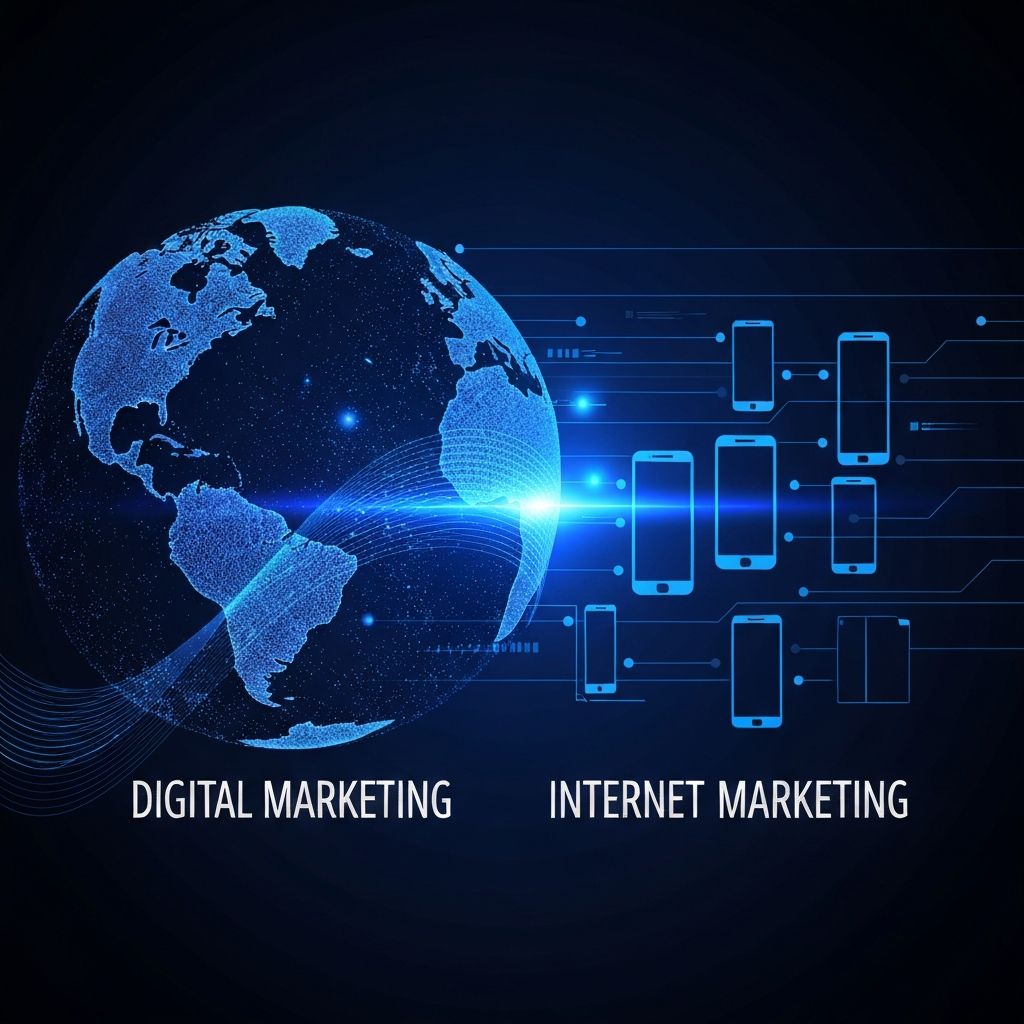
Digital marketing is a broader term. It includes everything internet marketing covers, but it also includes digital channels that do not require the internet. Examples include SMS marketing, in-app push notifications on cellular networks, digital billboards, smart TV advertising, podcast sponsorships, and even targeted ads inside connected vehicles. Any marketing that uses electronic devices or digital technology to reach an audience qualifies, whether or not it travels through the public internet.
This broader scope is increasingly important as more devices, screens, and platforms become part of everyday life. A modern marketing strategy might combine connected TV ads, in-store digital signage, and a fully optimized website into one coherent campaign. All of those tactics are digital marketing, but only some are technically internet marketing.
Key Differences Between the Two
The clearest difference is scope. Internet marketing is a subset of digital marketing. Every internet marketing tactic is digital, but not every digital marketing tactic is on the internet. Another difference is in measurement; internet marketing typically uses web analytics and ad platform dashboards, while digital marketing may pull data from a wider mix of sources, including telecom providers, retail point-of-sale systems, and connected device platforms.
Where the Two Overlap
In practice, most small and mid-sized businesses focus on the overlap. Their marketing budget is dominated by SEO, content, paid search, social ads, and email, all of which are both digital and internet marketing. For these companies, the distinction is mostly academic. The terminology only starts to matter when the business expands into channels like SMS campaigns, smart TV advertising, or connected device experiences.
Which One Is Right for Your Business?
Most businesses today need a strategy that is at least primarily internet marketing. Customers research products online, read reviews, compare prices, and increasingly purchase without ever speaking to a salesperson. A strong website, solid search engine optimization, and well-managed paid campaigns are non-negotiable starting points.
However, some industries benefit greatly from broader digital marketing. Retail brands use SMS for flash sales. Restaurants use digital signage and connected TV ads to drive local foot traffic. App-based services use push notifications to re-engage users. If your audience spends significant time on digital channels beyond the public web, expanding into broader digital marketing channels can unlock real growth.
Common Misunderstandings
One common misunderstanding is that digital marketing is a more advanced version of internet marketing, when really it is just a wider category. Another is that older channels like email or SEO are outdated; in fact, both remain among the highest-ROI tactics available. Business owners sometimes also assume that going digital means abandoning offline marketing entirely, but the most successful campaigns often integrate both, using digital tools to amplify and measure offline efforts.
Building an Integrated Strategy
The best approach is rarely an either/or decision. Start with your customer journey: where do prospects discover you, where do they evaluate options, and how do they ultimately decide to buy? Map digital and internet marketing tactics to each stage so that every touchpoint reinforces the next. Use shared analytics across channels so you can see how visitors move between them, and invest in the channels that demonstrably support your business goals.
Final Thoughts
Digital marketing and internet marketing are closely related, but they are not identical. Internet marketing lives entirely on the web; digital marketing extends to any channel powered by digital technology. Understanding the difference helps you choose tactics intentionally and explain your strategy clearly to stakeholders. Whether your focus is purely online or spans a wider digital ecosystem, what matters most is that the strategy is well-targeted, well-measured, and consistently improved.