
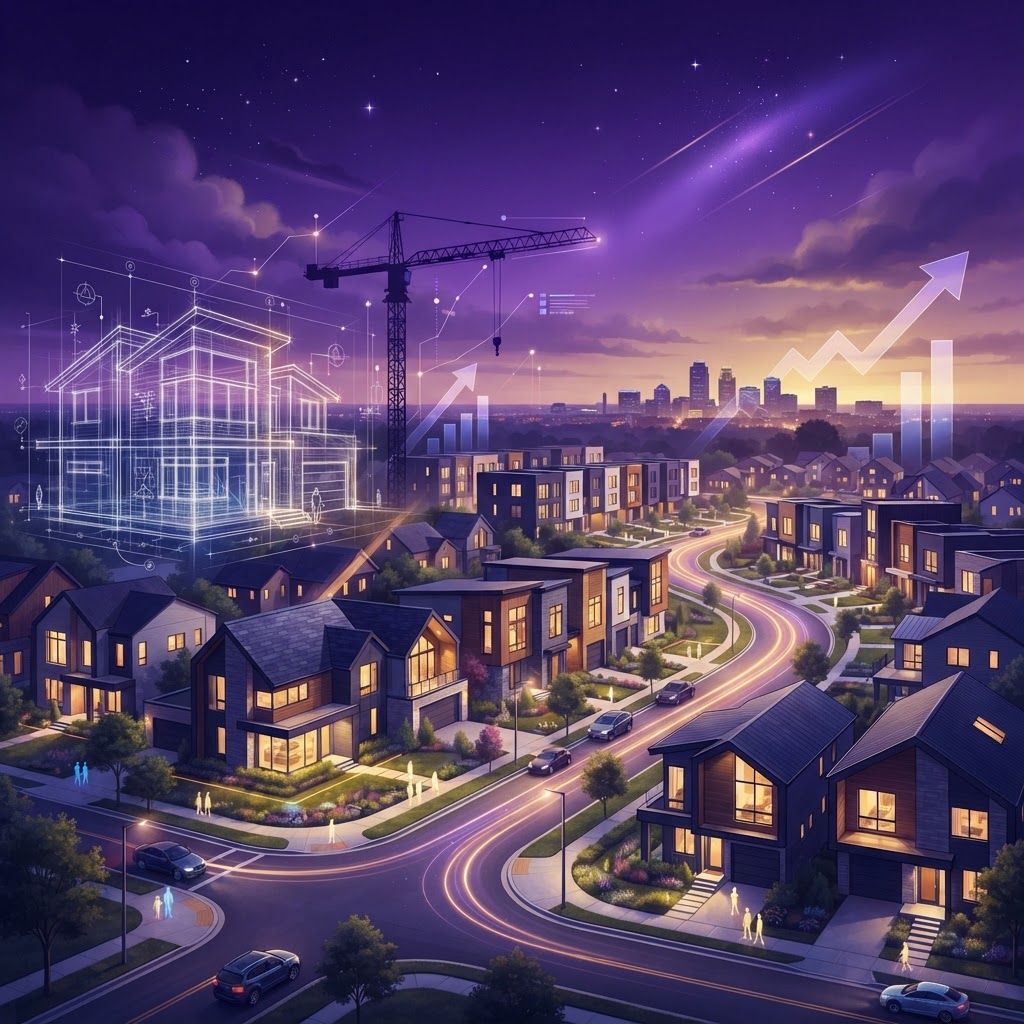
A Metro Building Faster Than Most
Des Moines has been among the Midwest's most consistent growth markets, and residential development reflects that. The suburban ring, particularly Waukee, Ankeny, Grimes, and Norwalk, has absorbed enormous new construction volume, while downtown and the East Village have seen substantial adaptive reuse and multifamily development.
The drivers are straightforward: a diversified employment base anchored by insurance, financial services, agriculture technology, and healthcare, combined with housing costs that remain reasonable relative to national averages. That combination sustains demand across price points, from entry-level production housing to custom estates.
Understanding the Developer Categories
Production builders construct from a defined set of floor plans at scale, offering efficiency, predictable pricing, and faster timelines with limited customization. Semi-custom builders start from base plans and allow meaningful structural and finish modification. Custom builders design each home individually, with the highest cost and longest timeline.
Land developers create the subdivisions themselves, handling infrastructure, platting, and lot sales to builders. Urban infill and multifamily developers work on a fundamentally different model, often involving historic tax credits, mixed-use programming, and municipal partnership.
The Ten Leading Residential Developers
1. Hubbell Realty Company
One of Iowa's oldest and most substantial development organizations, active across single-family subdivisions, multifamily communities, and mixed-use projects throughout the metro. Its scale and long history give it unusual capability to execute large master-planned developments and to hold land through market cycles.
2. Kading Properties
A significant force in the build-to-rent and single-family rental segment, developing entire neighborhoods of rental homes across central Iowa. This model has grown rapidly and addresses households wanting single-family living without ownership, a segment that traditional builders largely ignored.
3. Jerry's Homes
A long-established central Iowa builder with a reputation for solid construction at accessible price points. Its subdivisions appear throughout the suburban ring, and the company's longevity provides reassurance regarding warranty support and structural durability.
4. Classic Builders
A prominent metro production and semi-custom builder active in Waukee, Ankeny, and West Des Moines. Efficient construction timelines, a well-organized selection process, and consistent quality control at mid-market price points define its position.
5. Destiny Homes
Focused on the entry-level and first-move-up segments in growing suburbs, Destiny has built substantial volume by delivering functional, energy-efficient homes at competitive prices. Streamlined plan options keep timelines predictable.
6. Kimberley Development Corporation
A land development and homebuilding organization responsible for several major master-planned communities in the metro. Its work includes infrastructure development, amenity planning, and coordination among multiple builders within a single community.
7. Nelson Construction and Custom Home Builders of Central Iowa
The metro supports a healthy custom building sector serving clients who want architect-designed homes with individualized specifications. Custom builders differentiate on craftsmanship, subcontractor relationships, and project management rather than price.
8. Blackbird Investments
An urban development firm active in downtown Des Moines and surrounding neighborhoods, focused on adaptive reuse of historic buildings into residential units. Projects of this type require expertise in historic tax credits and complex financing structures that suburban builders do not need.
9. Nelson Development and East Village Residential Developers
Developers responsible for much of the residential density that transformed the East Village from warehouse district to one of the metro's most desirable neighborhoods. Mixed-use programming, combining ground-floor retail with upper-level residential, has been central to that success.
10. Diligent Development and Emerging Suburban Builders
Newer entrants building in Norwalk, Bondurant, Grimes, and Altoona as growth pushes outward. These builders often compete by offering more included features at given price points and shorter waitlists than established competitors.
Market Trends Shaping Development
Several forces are currently defining central Iowa residential development. Lot supply constraints in the most desirable school districts have pushed development into second-ring communities. Build-to-rent has emerged as a substantial product category with dedicated developers and financing.
Energy efficiency standards have risen, with tighter envelopes, better windows, and high-efficiency mechanical systems now common rather than premium. Downtown residential conversion continues, driven by employer proximity and demand for walkable living. And smaller lot sizes with alternative layouts have become common as land costs rise.
Guidance for Buyers
Research the builder's warranty terms and, more importantly, their actual responsiveness on warranty claims. Speaking with homeowners in a completed subdivision from the same builder is far more informative than any marketing material.
Understand what the base price includes and what the realistic all-in cost becomes after typical selections, since the gap can be substantial. Review the homeowners association structure, dues, and reserve funding before committing. Verify school district boundaries directly with the district rather than relying on sales representations, as boundaries shift in rapidly growing areas.
For custom builds, examine the contract's change order process and allowance structure closely, because those provisions determine how cost overruns occur.
Final Thoughts
Des Moines residential development offers genuine range: large diversified organizations executing master-planned communities, focused production builders in growth suburbs, custom builders serving the high end, and urban developers reshaping the core. Matching builder type to your priorities around customization, timeline, and budget is what produces a satisfying outcome.