
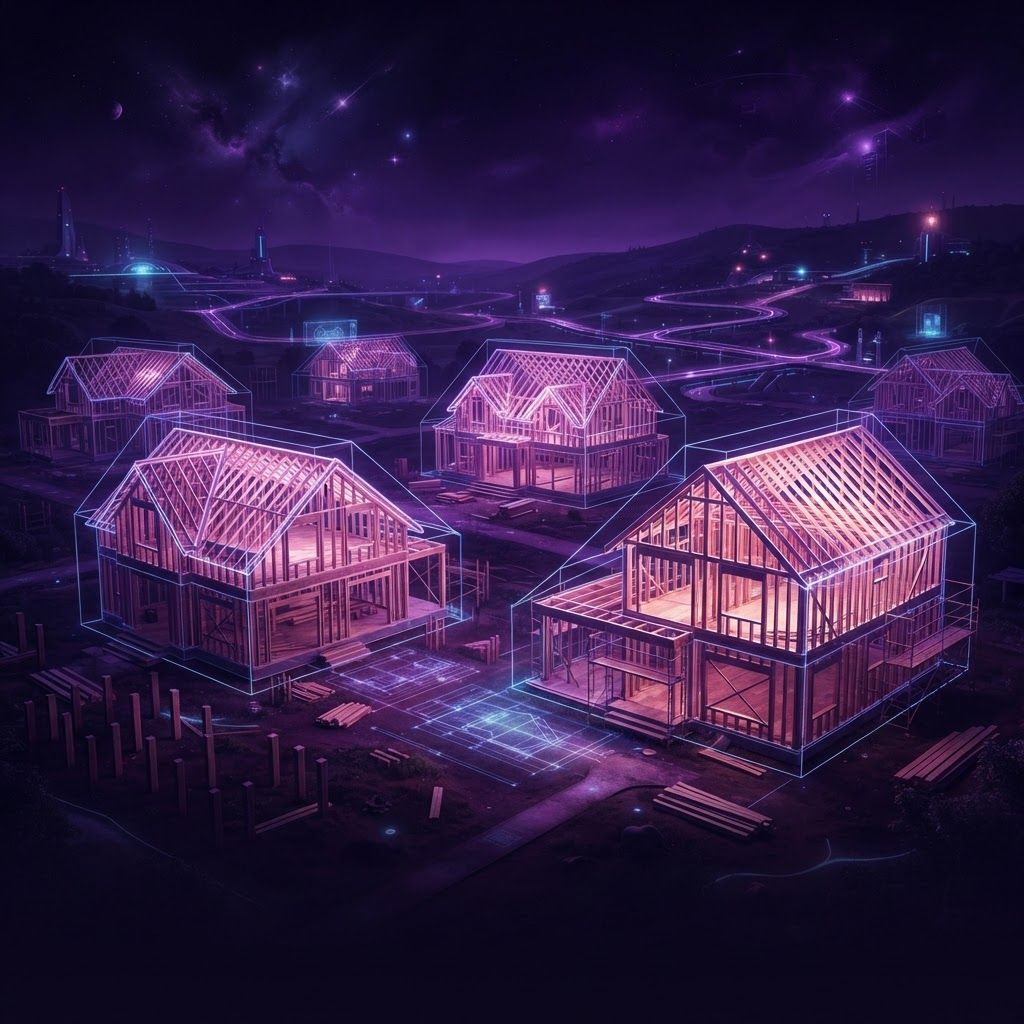
Residential Construction in Central Arkansas
Home building in Little Rock is shaped by conditions that are specific enough to matter. Much of Central Arkansas sits on expansive clay soils that swell when saturated and shrink during drought, which makes foundation engineering a genuine design question rather than a standard detail. Summer humidity combined with sustained high temperatures makes moisture management within wall assemblies critical, since a wall designed for a dry climate will trap condensation here. Spring severe weather argues for structural connection details and roof assemblies that resist uplift.
These are not exotic concerns, but they distinguish builders who have engineered for the region from builders applying generic plans. The categories below reflect how the local residential construction market has organized itself.
1. Custom Home Builders
Custom builders construct individual homes from unique plans on owner-selected lots. The process typically begins with a site evaluation, proceeds through design development with an architect or in-house designer, and continues through a construction period commonly running ten to eighteen months depending on scale and complexity.
The defining advantage is control. Every decision, from foundation type to window specification to cabinet hardware, belongs to the owner. The corresponding demand is decision volume, since a custom home requires hundreds of selections made on schedule. Builders who manage this well provide a selection calendar with deadlines tied to construction sequence, which prevents the delays that indecision otherwise causes.
2. Semi-Custom and Plan-Modified Builders
Semi-custom builders offer a portfolio of proven floor plans that buyers modify within defined parameters. This model captures most of the personalization value while retaining the cost and schedule efficiency of repeated construction.
Because the builder has constructed the plan before, material quantities are known, subcontractor pricing is established, and problem details have already been resolved. For buyers who like an existing plan and want changes rather than a blank sheet, semi-custom construction frequently delivers the best value in the Little Rock market.
3. Production and Tract Home Builders
Production builders construct homes in developed subdivisions from a fixed set of plans and finish packages. Efficiency comes from volume, standardization, and crews that repeat identical work across many units.
For first-time buyers and those prioritizing price and delivery certainty, production homes are a rational choice. Buyers should focus attention on what varies rather than what is fixed: lot selection and drainage, structural options, insulation and mechanical system upgrades, and the specific finish package included versus offered at additional cost. The upgrades worth paying for are usually the ones that cannot be changed later, particularly anything inside a wall.
4. Luxury and Estate Home Builders
The high end of the Little Rock market, concentrated in the Heights, Chenal, and select West Little Rock enclaves, is served by builders operating at a different level of detail. Work in this segment involves natural stone and specialty masonry, custom millwork and cabinetry, integrated home automation, geothermal or high-efficiency mechanical systems, and extensive outdoor living construction including pools, pavilions, and outdoor kitchens.
Luxury builders differentiate on craft execution and project management sophistication rather than price. Timelines extend accordingly, and buyers should expect eighteen months or more for a genuine estate build.
5. Green and High-Performance Home Builders
A growing segment focuses on energy performance and building science rather than square footage. These builders emphasize continuous air sealing verified by blower door testing, advanced framing to reduce thermal bridging, high-performance windows, right-sized and properly commissioned mechanical systems, and controlled ventilation with dehumidification.
The Arkansas climate makes this approach financially rational rather than merely virtuous. Cooling loads dominate the annual energy budget, and a tightly sealed, well-insulated envelope with a correctly sized system reduces those costs substantially while improving comfort and humidity control. Buyers should ask specifically for blower door results and duct leakage testing rather than accepting general efficiency claims.
6. Modular and Off-Site Construction Providers
Modular construction builds volumetric sections in a controlled factory environment and assembles them on a prepared foundation. The advantages are weather-independent construction quality, dimensional precision, and compressed on-site schedules.
Modular homes built to residential code are permanent real property and finance and appraise as conventional construction, which distinguishes them from manufactured housing. In a climate with a long rainy season, avoiding weather exposure during framing and finishing has real quality value.
7. Infill and Urban Residential Builders
Little Rock has substantial infill opportunity in established neighborhoods, and builders specializing in this work manage constraints that greenfield builders never face. Narrow lots limit equipment access and material staging, existing utilities may need upgrading or relocation, neighborhood context and sometimes overlay district requirements govern design, and adjacent structures require protection during excavation.
Infill builders also navigate the tension between contemporary construction and established streetscape character, which requires design sensitivity as much as construction skill.
8. Home Addition and Structural Expansion Specialists
Additions occupy a middle ground between renovation and new construction, and they are technically demanding. Tying new foundation to existing foundation without differential settlement, matching or deliberately contrasting exterior materials, extending mechanical and electrical systems that may be at capacity, and maintaining a weather-tight envelope while the existing structure is opened all require careful sequencing.
In Central Arkansas, foundation tie-in deserves particular engineering attention because of soil movement characteristics. A new addition on a different foundation system than the original house will move differently, and the resulting cracks appear at the joint.
9. Multifamily and Small-Scale Residential Developers
Duplexes, fourplexes, townhomes, and small apartment buildings serve the Little Rock rental market and are built by contractors who understand both construction and investment economics. Work in this segment requires attention to sound transmission between units, fire separation assemblies, individual metering, and durability specifications appropriate to rental turnover.
The best builders in this category advise owners on the long-term maintenance cost implications of finish choices, which matters far more in rental property than in owner-occupied construction.
10. Rural and Acreage Home Builders
Outside the Little Rock metro core, builders serving Faulkner, Saline, Lonoke, and Pulaski county acreage handle a distinct set of requirements. Sites often need well and septic system design and permitting, utility extensions, driveway and culvert construction, and grading for drainage across larger areas.
These builders also frequently construct accessory structures such as shops, barns, and equipment buildings as part of an overall property plan, and coordinating those with the residence in a single project reduces mobilization costs.
What Actually Matters in Local Specifications
Foundation design deserves the most scrutiny. Given expansive soils across much of the region, a geotechnical evaluation of the specific site is worthwhile even when not strictly required. Builders should be able to explain the foundation approach, drainage strategy around the structure, and grading plan for moving water away from the building.
Envelope moisture management follows closely. In a hot humid climate, the assembly must allow drying and must not place a vapor barrier in a position that traps condensation. Proper flashing at windows, doors, and roof penetrations prevents the water intrusion that causes the majority of expensive building failures.
Mechanical system sizing and duct design affect comfort more than equipment brand. Oversized systems short cycle, fail to dehumidify, and waste energy. A builder who performs a room-by-room load calculation rather than sizing by square footage rule of thumb is demonstrating real competence.
Realistic Timeline Expectations
A production home in a developed subdivision typically completes in five to eight months from permit. A semi-custom home runs eight to twelve months. A genuine custom home commonly requires twelve to eighteen months, and estate construction can extend beyond two years. Design and permitting precede all of that and can add several months on custom work.
Weather is a real factor locally. Extended spring rainfall delays excavation, foundation work, and framing, and prudent schedules include contingency for it rather than pretending otherwise.
Final Thoughts
Little Rock residential construction spans everything from efficient production housing to high-performance custom building and rural acreage work. The builders who consistently satisfy owners share concrete practices rather than marketing claims: site-specific foundation engineering, verified envelope performance, load-calculated mechanical design, honest allowances, and disciplined communication across a long timeline. Evaluating builders against those specifics produces far better decisions than comparing price per square foot alone.