
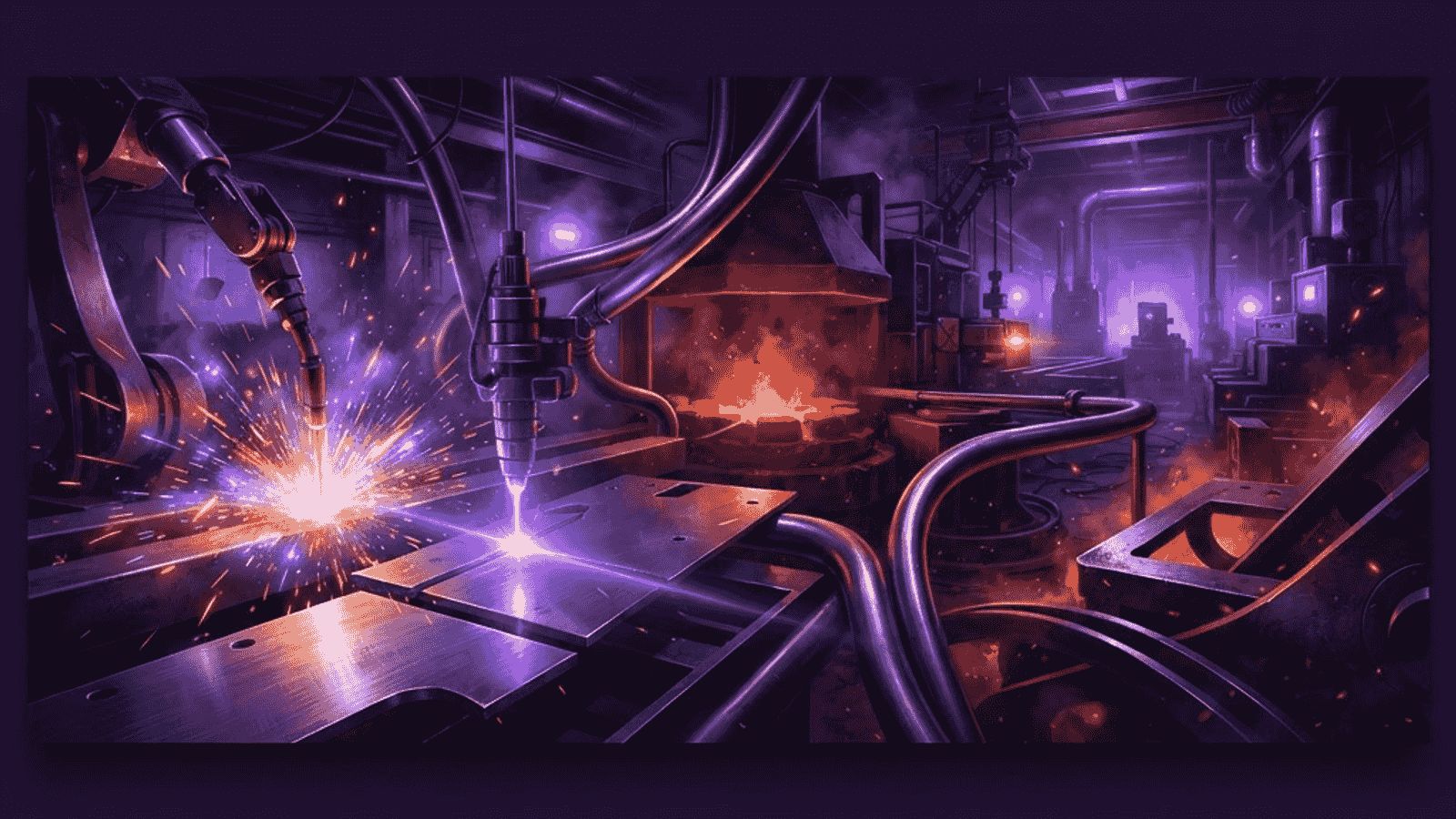
Metal Fabrication as Stockton's Industrial Foundation
Metalworks is the industry that makes other industries possible. Machinery frames, conveyor structures, processing tanks, building steel, equipment guards, and thousands of machined components all originate in fabrication shops, and Stockton has an unusually strong concentration of them. The city's agricultural equipment heritage created the demand, and generations of welders, machinists, and fabricators built the skill base that sustains it.
Today the local metalworks sector serves food processing plants, warehouses, water districts, construction contractors, energy projects, and equipment manufacturers throughout the Central Valley. The work ranges from a single repaired bracket to multi ton structural assemblies, and the shops that do it well occupy an essential position in the regional economy.
Capabilities Across the Local Industry
Structural steel fabricators produce building frames, platforms, mezzanines, and support structures, typically working from engineered drawings. Precision machining shops perform turning, milling, grinding, and boring to tight tolerances for components and tooling. Sheet metal fabricators cut, form, and assemble panels, enclosures, ductwork, and guards.
Cutting specialists operate laser, plasma, and waterjet equipment producing accurate profiles from plate and sheet. Welding and assembly shops join components into finished weldments, often combining multiple processes. Tank and vessel fabricators build stainless processing tanks for food, beverage, and chemical applications. Finishing operations provide powder coating, galvanizing, painting, and passivation that determine service life.
Ten Notable Metalworks Companies Serving Stockton
Delta Structural Steel Fabricators produces building frames, platforms, and heavy weldments for commercial and industrial construction, working from engineered drawings with certified welding procedures.
Valley Precision Machining delivers tight tolerance turning, milling, and grinding for machinery components, tooling, and replacement parts serving agricultural and food processing equipment.
San Joaquin Sheet Metal Works fabricates enclosures, panels, guards, and ductwork, combining shearing, forming, punching, and assembly for both production runs and one off requirements.
Portside Laser and Waterjet Cutting provides high accuracy profile cutting in steel, stainless, and aluminum, supplying blanks and finished parts to other fabricators and manufacturers throughout the region.
Central Valley Stainless Tank Company builds sanitary processing tanks, hoppers, and vessels for food, beverage, and dairy customers, where weld quality and surface finish directly affect food safety compliance.
Stockton Welding and Repair Services handles field repair, on site welding, and emergency service for processing plants and agricultural operations where downtime is measured in thousands of dollars per hour.
Bridgeway Metal Forming performs press brake forming, rolling, and stamping, producing formed components and profiles for equipment builders and construction suppliers.
Northgate Industrial Coatings provides powder coating, industrial painting, and surface preparation, protecting fabricated steel against the moisture, chemicals, and ultraviolet exposure typical of valley service conditions.
Riverbend Custom Fabrication engineers and builds one off equipment, conveyor structures, and specialized assemblies for customers whose needs fall outside standard product catalogs.
Cannery District Machine and Weld combines machining with welding and assembly to rebuild and modify existing industrial equipment, extending asset life economically.
Certifications and Quality Indicators
Welding credentials are the clearest quality signal in metalworks. Certified welding procedures qualified to recognized structural or pressure codes, along with individually qualified welders, demonstrate that joints are produced to defined standards rather than personal habit. For structural building steel, fabricator certification programs verify shop wide quality systems.
Inspection capability supports those credentials. Visual inspection, dye penetrant, magnetic particle, ultrasonic, and radiographic testing each detect different defect types, and shops with in house or contracted nondestructive testing provide verifiable assurance rather than assurances alone.
Dimensional control matters for machined and assembled work. Coordinate measuring machines, calibrated gauging, and documented first article inspection prevent accumulated tolerance problems that only appear during final assembly. Ask how a shop calibrates instruments and documents inspection results.
Engineering support distinguishes a fabrication partner from a job shop. Detailing capability, weldment design review, material substitution advice, and design for manufacturability input reduce both cost and risk. Shops employing engineers or experienced detailers deliver value that pure build to print operations cannot.
Trends in Metal Fabrication
Automation continues to expand shop capability. Fiber laser cutting, robotic welding cells, automated press brakes, and computer numerical control machining centers have raised both accuracy and throughput while reducing dependence on scarce skilled labor. Shops that invested in this equipment compete on consistency rather than headcount.
Digital workflow integration is equally significant. Three dimensional modeling, nesting software that minimizes material waste, and shop floor scheduling systems shorten quote to delivery cycles and reduce errors introduced by manual data handling.
Workforce development remains the industry's central challenge. Experienced welders and machinists are retiring faster than they are being replaced, and shops partnering with regional community colleges and apprenticeship programs on training pipelines are the ones sustaining capacity for the long term.
Sustainability appears in metalworks primarily through material efficiency and recycling. Steel and aluminum are infinitely recyclable, and shops that optimize nesting, capture and sell scrap responsibly, and reduce energy consumption in cutting and finishing lower both cost and environmental impact.
Selecting the Right Fabrication Partner
Match capability to requirement precisely. Sanitary stainless tank work demands a shop with food industry experience and appropriate finishing capability. Structural building steel demands code certification. A prototype bracket demands flexibility and quick turnaround rather than production infrastructure.
Provide complete information when requesting quotes, including material specification, tolerances, welding requirements, finish, quantity, and delivery expectations. Incomplete drawings produce inflated quotes as shops price uncertainty into their bids.
Visit prospective shops. Equipment condition, organization, weld quality on work in process, and how staff discuss problems tell you more than any capability list. Among Stockton's metalworks companies, the shops with the longest customer relationships have typically earned them by delivering on schedule and standing behind their work when something went wrong, and that track record is the most reliable predictor of future performance.