
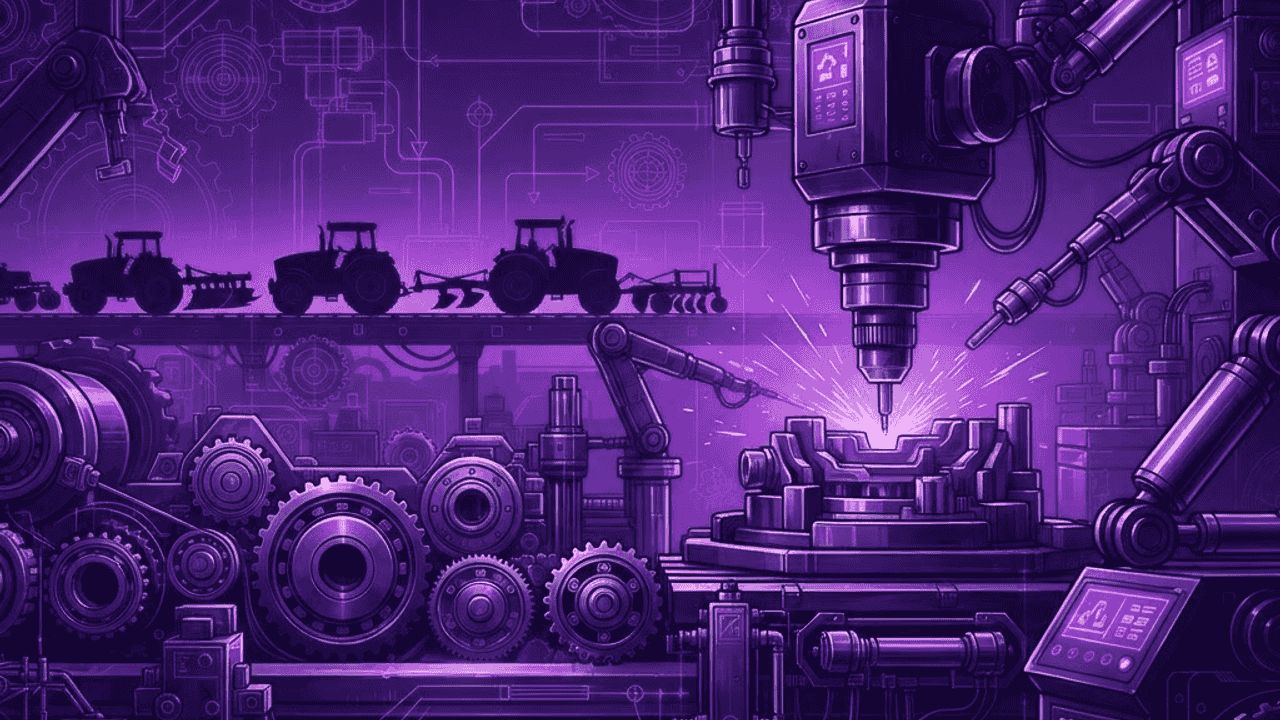
A Manufacturing Tradition Rooted in the Valley
Few American cities have as legitimate a claim to machinery heritage as Stockton. The region's agricultural abundance created relentless demand for equipment that could harvest, sort, process, and move enormous volumes of crops, and local builders answered with inventions that spread worldwide. That legacy is not merely historical decoration. It established a workforce, a supplier network, and an engineering culture that still define machinery manufacturing in San Joaquin County today.
Modern Stockton machinery builders serve agriculture, food and beverage processing, water management, materials handling, and general industry. The common thread is equipment designed to survive demanding duty cycles in dusty, wet, hot, and abrasive environments where consumer grade engineering fails within a season.
The Machinery Categories That Matter Here
Agricultural equipment remains foundational, encompassing harvesting machinery, tillage implements, nut and fruit processing lines, and irrigation hardware. Food processing machinery represents a natural extension, since crops grown nearby must be washed, sorted, dried, canned, or frozen before shipping. Materials handling equipment, including conveyors, elevators, and bulk handling systems, ties the two together.
Beyond agriculture, local builders produce custom industrial machinery, machine tools and tooling, hydraulic and pneumatic systems, and packaging equipment. Automation integration has become a category in itself, with firms specializing in robotics, vision systems, and programmable controls retrofitted onto both new and existing production lines.
Ten Notable Machinery Manufacturers Serving Stockton
Valley Harvest Machinery designs and builds harvesting and post harvest handling equipment for nut, grape, and tomato producers. Deep familiarity with local crop conditions allows engineering choices that generic equipment catalogs cannot match.
San Joaquin Food Processing Equipment manufactures washing, sorting, and conveying systems for canneries and packing houses. Sanitary design, washdown durability, and stainless construction define this specialty, where food safety regulation dictates engineering standards.
Delta Industrial Machine Works builds custom machinery to customer specification, taking projects from concept through design, fabrication, assembly, and commissioning. Custom builders like this solve problems no catalog product addresses.
Stockton Precision Machine and Tool produces tooling, fixtures, and precision machined components supporting other manufacturers. Capability in CNC turning, milling, and grinding to tight tolerances makes it a supplier of last resort for difficult parts.
Central Valley Conveyor Systems engineers bulk material handling, from belt and screw conveyors to bucket elevators serving grain, aggregate, and processing facilities. Correct conveyor design prevents the bottlenecks that limit an entire plant's throughput.
Portside Hydraulic Machinery specializes in hydraulic power units, cylinders, and integrated systems used across agricultural, marine, and industrial equipment, an area demanding both mechanical and fluid dynamics expertise.
Bridgewater Automation Engineering integrates robotics, servo motion, vision inspection, and programmable logic control into production lines. Automation integrators have become essential as labor availability tightens across the valley.
Northgate Fabrication and Machinery combines heavy steel fabrication with machining and assembly, producing large structural machinery frames, tanks, and weldments that smaller shops cannot handle.
Cannery District Equipment Company rebuilds, retrofits, and modernizes existing processing machinery, extending useful life at a fraction of replacement cost while upgrading controls and safety systems.
Riverbend Packaging Machinery manufactures filling, sealing, labeling, and case packing equipment for beverage and food producers, a segment growing alongside regional wine, juice, and specialty food production.
Evaluating a Machinery Manufacturer
Engineering depth is the first consideration. Ask whether the builder employs mechanical, electrical, and controls engineers, whether it performs finite element analysis on structural components, and whether it can produce complete documentation packages. Machinery without proper drawings, bills of material, and electrical schematics becomes a maintenance nightmare within a few years.
Safety compliance is not optional. Machine guarding, emergency stop circuits, lockout provisions, and risk assessment documentation protect operators and shield owners from liability. Reputable builders follow established machine safety standards and can explain exactly how a design meets them.
Service and parts support determine long term value. A machine is a fifteen to twenty five year investment, and support quality matters more than purchase price. Investigate parts availability, technician response time, remote diagnostic capability, and whether the manufacturer maintains records of each machine it has built.
Technology Trends in Machinery Manufacturing
Automation and robotics continue their steady advance. Rising labor costs and persistent workforce shortages across the Central Valley have made automated sorting, packing, and palletizing economically compelling even for mid sized operations that resisted it a decade ago.
Connected machinery, often described as industrial internet of things capability, allows equipment to report performance data, predict component failures, and enable remote troubleshooting. Predictive maintenance replaces reactive repair, reducing unplanned downtime that costs processors far more than the machinery itself.
Energy efficiency has grown in importance as electricity costs climb. Variable frequency drives, efficient motors, heat recovery, and optimized hydraulic circuits reduce operating expense meaningfully over a machine's life. Water conservation features carry similar weight in a drought conscious state.
Digital design and simulation shorten development cycles. Three dimensional modeling, kinematic simulation, and additive manufacturing for prototypes and low volume parts let builders validate concepts before committing to steel.
Getting the Specification Right
Most machinery disappointments trace back to inadequate specification rather than poor construction. Define throughput requirements, product characteristics, available floor space, utility availability, sanitation requirements, and expected duty cycle clearly before soliciting proposals. Involve maintenance staff early, since they will live with access and serviceability decisions for decades.
Request references and visit installations of similar equipment where possible. Talking with an operator who has run a machine for three years reveals more than any specification sheet. Stockton's machinery community is small enough that reputations are well known, and builders who have thrived across generations of valley agriculture have done so by delivering equipment that keeps running long after the sale.