
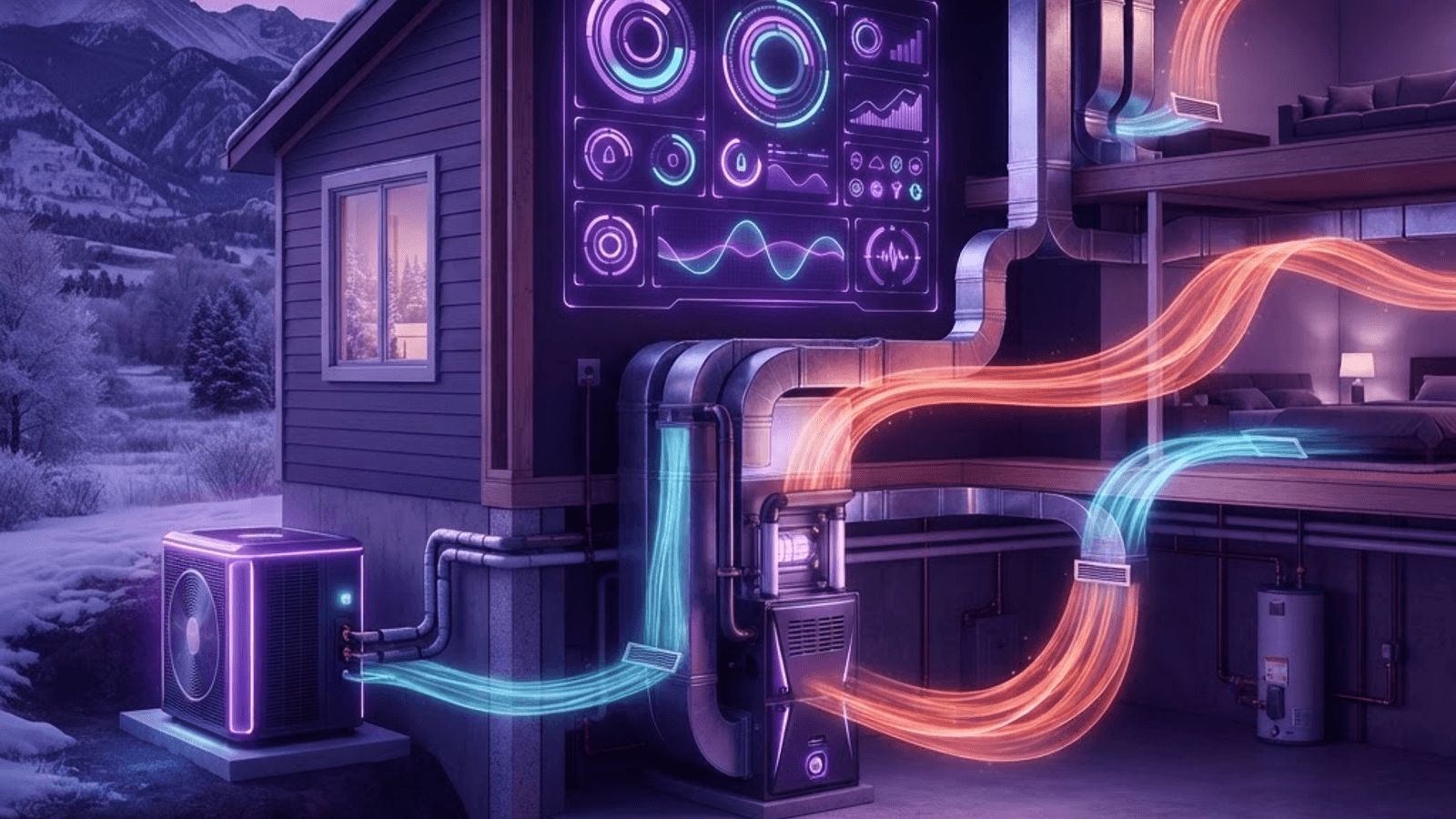
Climate Control in a Demanding Environment
Fort Collins experiences a climate that challenges heating and cooling equipment from both directions. Winter nights regularly drop well below freezing while summer afternoons can climb into the nineties, sometimes within the same month. The air is dry year round, elevation reduces air density and affects combustion and airflow calculations, and strong solar gain through windows can overheat rooms even on cool days.
These conditions make proper system design more important than brand selection. An oversized air conditioner cools quickly but cycles too frequently to manage humidity or maintain even temperatures. An undersized heating system struggles during cold snaps. Duct systems that were never balanced leave upstairs bedrooms uncomfortable regardless of equipment quality.
What Quality HVAC Work Involves
Load calculation is the starting point for any competent installation. A proper analysis considers square footage, insulation levels, window area and orientation, air leakage, and occupancy rather than simply matching the size of the old unit. Skipping this step is the most common cause of persistent comfort complaints.
Duct design and sealing follow closely. Leaky or poorly sized ductwork can waste a large share of conditioned air, particularly when runs pass through unconditioned attics or crawlspaces. Sealing and balancing frequently improve comfort more than new equipment would.
Installation quality determines whether rated efficiency is actually achieved. Correct refrigerant charge, proper airflow, accurate combustion setup, condensate management, and thorough commissioning separate professional work from equipment swaps.
Maintenance programs round out a strong service offering. Seasonal inspections catch failing capacitors, dirty coils, and combustion issues before they become emergency failures during the coldest or hottest week of the year.
Notable HVAC Companies Serving Fort Collins
Front Range Heating and Air provides full residential service including furnace and air conditioner replacement, repair, and maintenance plans, with a reputation for thorough system evaluation. Choice City Climate Systems serves homes and small businesses and is frequently praised for clear explanations and honest repair recommendations.
Poudre Valley Heat Pump Specialists focuses on air source and cold climate heat pumps, including dual fuel configurations that suit Colorado winters. Rocky Mountain Indoor Air Quality concentrates on filtration, ventilation, humidification, and duct cleaning, addressing the dryness and dust common in the region.
Larimer Commercial HVAC handles rooftop units, building automation, and larger mechanical systems for offices, retail, and light industrial facilities. Old Town Boiler and Radiant Services specializes in hydronic heating, boilers, and radiant floor systems still common in older homes and popular in new mountain-style construction.
Northern Colorado Ductwork Solutions focuses on duct design, sealing, and balancing, often resolving comfort problems without replacing equipment. Horsetooth Furnace Repair provides emergency heating service with extended winter availability.
Cache la Poudre Geothermal Systems installs ground source heat pump systems for clients prioritizing long-term efficiency on suitable properties. Mountain Vista Air Conditioning completes the list with cooling-focused services including ductless mini-split installation for additions, basements, and homes without existing ductwork.
Trends in Heating and Cooling
Heat pumps represent the most significant shift in the industry. Cold climate models now maintain effective heating at low outdoor temperatures, and dual fuel systems pair a heat pump with a gas furnace for the coldest periods. Adoption along the Front Range continues to accelerate as efficiency improves and electrification advances.
Ductless mini-split systems have expanded beyond niche applications. They provide zoned comfort in additions, converted basements, garages, and older homes where adding ductwork is impractical.
Smart controls and variable-speed equipment have improved comfort significantly. Modulating furnaces and variable-capacity compressors run longer at lower output, producing steadier temperatures and better air mixing than older single-stage equipment. Indoor air quality has also become a mainstream concern, with better filtration, energy recovery ventilation, and whole-home humidification increasingly specified in a climate where winter indoor humidity can fall uncomfortably low.
How to Choose an HVAC Contractor
Ask whether the company performs a documented load calculation before recommending equipment size. A contractor who quotes a system based only on the existing unit is not designing, only replacing.
Request proposals that specify equipment model numbers, efficiency ratings, duct modifications, thermostat type, and warranty terms for both parts and labor. Confirm that permits and inspections are included where required.
Ask about commissioning procedures, including airflow measurement and refrigerant verification, and whether a follow-up visit is included. Evaluate maintenance plan value carefully, focusing on what inspections actually include rather than discount percentages alone.
Seasonal Maintenance That Protects Equipment
Heating and cooling equipment rewards routine attention. Filters should be checked monthly and replaced according to type and household conditions, since restricted airflow reduces efficiency and strains blowers and compressors. Outdoor condenser coils accumulate cottonwood seed, dust, and grass clippings during Colorado summers and need periodic cleaning to shed heat effectively.
Fall inspections matter most for combustion equipment. Technicians check heat exchangers for cracks, verify burner operation and venting, test safety controls, and confirm combustion efficiency. Carbon monoxide detection should be verified at the same time. Spring visits focus on refrigerant charge, electrical connections, condensate drainage, and thermostat calibration.
Homeowners can also improve performance without service calls by keeping supply and return registers unobstructed, maintaining consistent thermostat schedules rather than large temperature swings, and addressing obvious air leaks around windows, doors, and attic hatches that force equipment to work harder than necessary.
Final Thoughts
Heating and cooling systems consume a large share of household energy and directly shape daily comfort. In Fort Collins, wide temperature swings and dry air reward careful design and installation far more than premium branding. Contractors who calculate loads, address ductwork honestly, and commission systems properly deliver comfort that cheaper equipment swaps rarely match.